Skip to content
Quick answer: The right custom padel racket balances shape, materials (fiberglass vs 3k/12k/18k carbon1), and manufacturing choices to meet your target player profile, margin goals, and launch timeline—choose teardrop for all-around appeal, pick carbon layups when you can command a premium, and work with an OEM2 that offers clear MOQ3, sampling speed, and robust QC4 so your private-label launch hits specifications and schedule.
Why this guide matters for sourcing managers
You’re evaluating custom padel racket options to decide whether a pilot run will increase brand recognition and sales without blowing your timeline or margin. This guide translates technical choices into procurement decisions: how shape affects player experience, what each material costs (and what it delivers), tooling and printing trade-offs, realistic MOQ3 and lead times, and the QC4 checkpoints you must require from an OEM2 like NEX Padel.
What buyers typically worry about (and how we answer them)
- Will a different shape actually change player performance? Yes—shape defines sweet spot5 and play style.
- How much more should I pay for carbon vs fiberglass? Expect higher material cost but higher perceived value and margin.
- What are realistic MOQs and lead times for a custom design? Plan for sampling (2–6 weeks) and production (30–60+ days) depending on tooling and quantity.
- What questions to ask an OEM? We give a checklist you can use in an RFQ.
Use case framing: three buyer scenarios
- Fast-to-market starter brand: prioritize low tooling cost, flexible colors, and quicker sampling—consider fiberglass core with standard Round shape.
- Mid-tier performance brand: seek a teardrop with a 3k carbon face and custom printing; balance cost and performance.
- Premium brand: specify 12k/18k carbon, diamond shape for power models, premium grip and custom packaging—expect higher MOQ and longer lead time but stronger retail ASP.
Core technical decisions and procurement impact
- Shape — the primary product-definition choice
- Round: largest control-focused sweet spot; forgiving; easier to sell to beginners. Lower rejection rate in play tests.
- Teardrop: balanced power-control; sweet spot slightly higher than round—best selling mid-level shape. Ideal if you want fewer SKUs that appeal broadly.
- Diamond: high power, sweet spot high on the head; preferred by advanced players seeking aggressive play. Often positioned as “pro” or “power” model.
Image: shape/comparison visualization
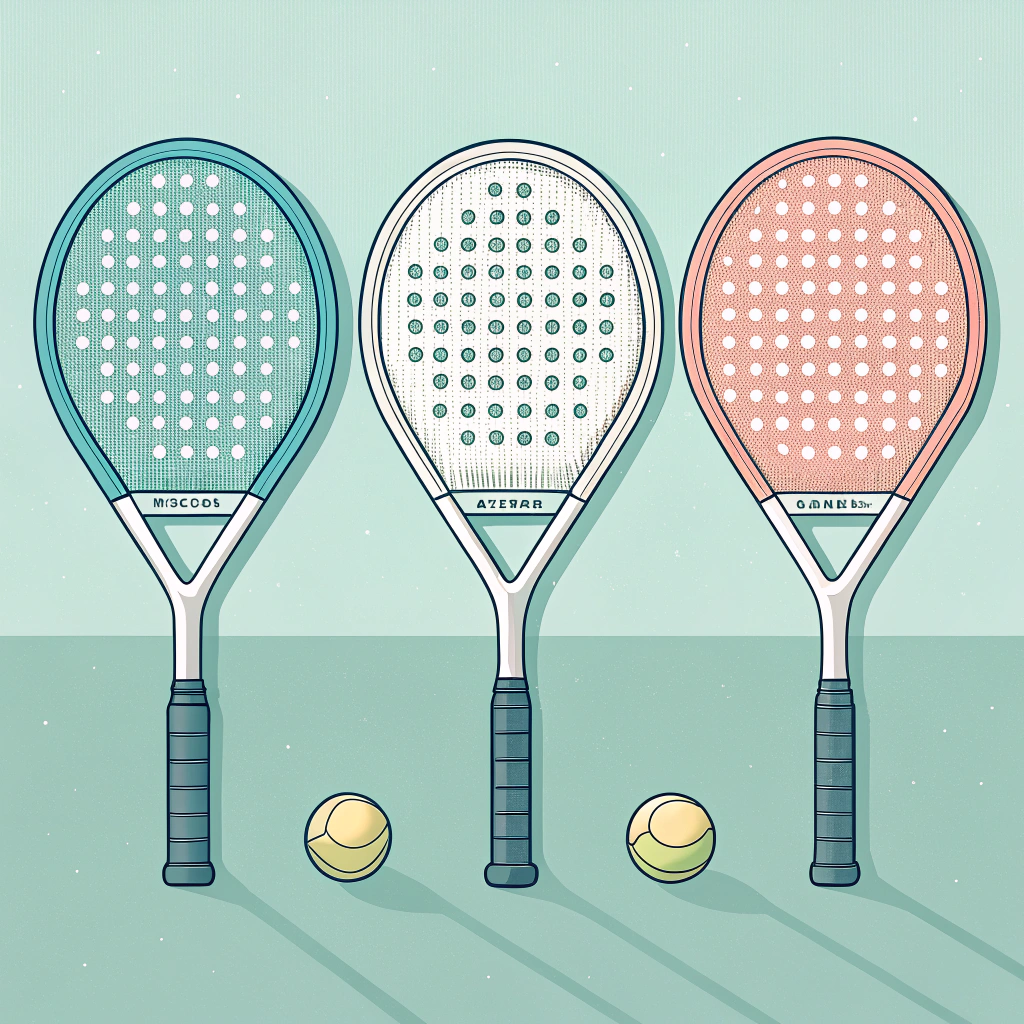
Procurement impact: shape changes the mold. If you request a custom shape beyond standard Diamond/Round/Teardrop, expect additional tooling cost and 2–4 weeks for a new mold prototype. Standard shapes usually share existing molds—lowering cost and lead time.
- Materials — how layup choices change cost, feel and durability
- Fiberglass: lowest material cost, softer feel, more control at the expense of power; good for entry-level lines and lower price points.
- 3k carbon (standard woven carbon): commonly used for balanced performance; relatively affordable among carbon options; crisp feel and improved durability.
- 12k carbon: fewer filaments per bundle than 3k? In practice 12k offers a smoother surface and different stiffness; oftenpreferred when targeting premium feel with reasonable cost.
- 18k carbon: finer finish and higher stiffness; used for top-end models where premium feel and aesthetics matter.
Table: quick material comparison
| Material | Typical cost impact vs fiberglass | Performance profile | Best use |
|---|---|---|---|
| Fiberglass | Base (lowest) | Soft feel, more control, lower power | Entry-level and budget lines |
| 3k Carbon | +15–35% | Balanced power/control, good durability | Mid-range performance models |
| 12k Carbon | +25–45% | Smoother finish, stiffer response | Premium mid-to-high models |
| 18k Carbon | +35–60% | High stiffness, premium feel & finish | High-end / brand flagship models |
Note: price deltas are illustrative—get quotes from your OEM for precise numbers. Labor, printing, and custom grips also materially affect final unit cost.
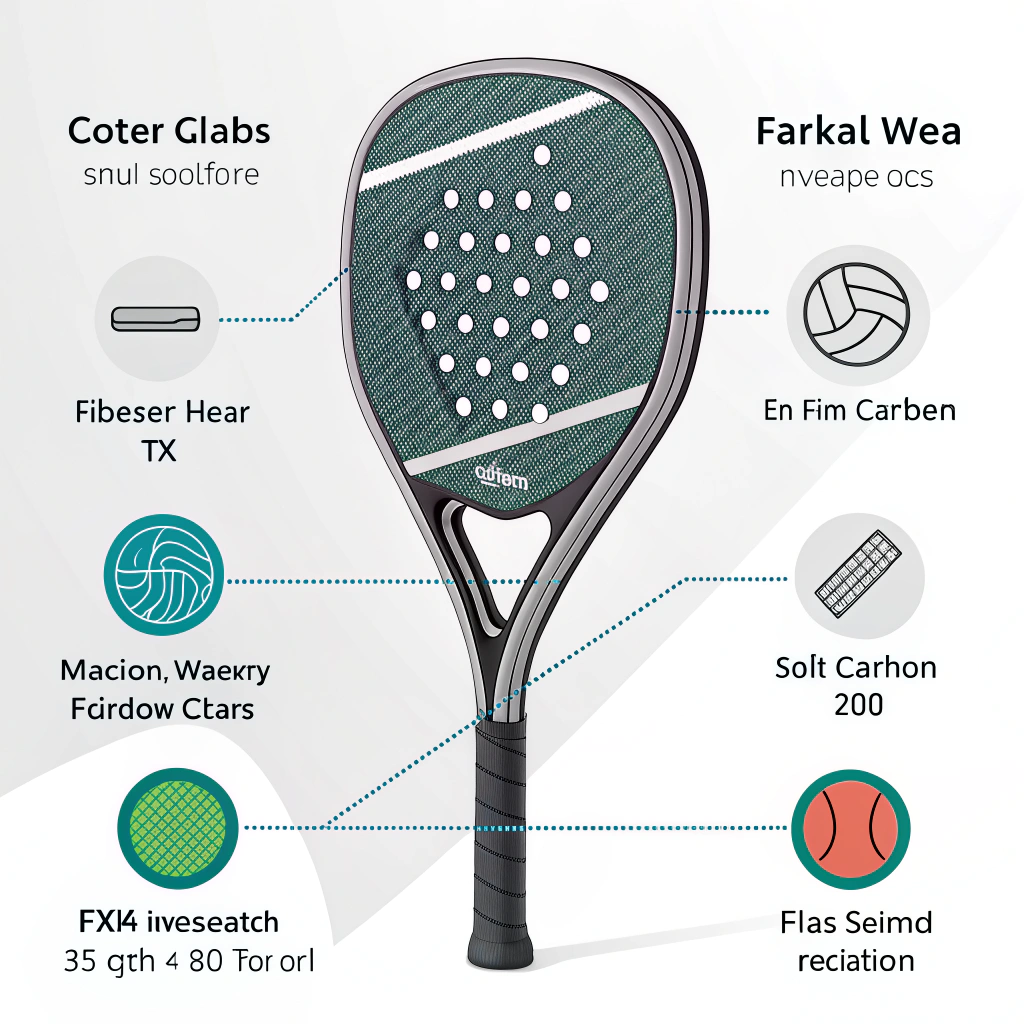
Image: cross-section of layups and feel
- Surface finishing and custom branding options
Common printing methods:
- UV printing — sharp, full-color graphics directly on the racket; durable and suitable for small to mid runs.
- Transfer/heat sublimation — excellent for full-wrap, complex graphics; good for higher volumes and premium finishes.
- Pad/screen printing — cost-effective for single-color or limited-color logos.
Customization available from NEX Padel:
- Full-color printing, custom pantone matches, matte/gloss finishes, embossed logos, and custom hand grip colors and logos. We also supply optional custom end caps and handle covers.
Packaging and accessory options:
- Single blister or retail box, foam inserts, multi-racket retail sets, and branded carry bags. Consider pressurized tube packaging for accompanying balls to maintain pressure lifespan if you source balls with rackets.
- MOQ, sampling, and lead time realities
- Sampling: 1–3 functional samples per model recommended. Typical sampling timeline: 2–4 weeks if using existing molds; 4–8+ weeks if new tooling is required.
- MOQ: Common ranges for custom padel rackets are 300–1000 units per SKU. NEX Padel often supports lower pilot runs for qualified clients—ask for specifics.
- Mass production lead time: 30–60 days after sample approval depending on order size, material availability, and factory schedule. Peak seasons (pre-summer) add 2–4 weeks.
Tip: Negotiate phased delivery—first batch smaller (pilot) with agreed schedule, remainder after sales feedback.
- QC checklist you must require in your RFQ
- Weight tolerance (±g target) and balance point measurement.
- Impact test: standardized ball-impact checks to ensure core integrity.
- Surface adhesion / print durability under abrasion testing.
- Tolerance on thickness and roundness of the edge.
- Glue/assembly checks on handle and grip adhesion.
- Random pull and drop tests for packaging.
Ask your OEM for test reports and photos for the first production lot. Require a pre-shipment inspection (PSI) by a third party if you don’t have in-house QC presence.
Image: QC testing and packaging examples

Cost-to-margin and ROI thinking for private-label launches
- Price premium: Moving from fiberglass to 3k/12k/18k carbon typically allows you to increase retail price by 20–60%, depending on brand positioning. Factor this against a 15–50% higher unit cost.
- Break-even: A smaller MOQ with premium materials may still be profitable if unit margin after COGS and logistics allows marketing support. Run a simple model: (Estimated Retail Price – Retailer Margin – Distributor Costs – COGS) × Units to determine gross profit.
- Cross-sell: Pair higher-margin rackets with your branded balls (45% or 57% wool) and accessories to increase average order value.
Practical negotiation levers with your OEM
- Consolidate SKUs to reach MOQ (same mould, different prints).
- Use existing molds to avoid tooling fees.
- Bundle printing/packaging orders for cost efficiencies.
- Lock-in material pricing in contract if large buy.
- Request pre-production photos and a short video of testing on first production lot.
Sample RFQ checklist (copy/paste in your sourcing email)
- Desired shape(s): Diamond / Teardrop / Round (specify if custom).
- Material specification: face weave (3k/12k/18k), core type (EVA density), thickness.
- Printing: method, Pantone references, gloss/matte.
- Grips: color, logo embossing, replacement grip options.
- Packaging: retail box spec or bulk.
- Sample timeline and cost.
- MOQ, lead time for 500 / 1,000 / 5,000 units.
- QC standards and required test reports.
- Warranty and defect rate terms.
Case example (practical)
A mid-sized European brand wanted a “mid-power” teardrop model to sit above their beginner line. Choice: 3k carbon face + medium-density EVA core + teardrop standard mold + UV full-color branding. Result: sample in 3 weeks (existing mold), MOQ 500, lead time 35 days. Retailed 30% above entry model and achieved faster sell-through in specialty stores due to better perceived performance and premium finish.
Final recommendations — procurement action plan (3 steps)
- Decide target player and price position (entry / mid / premium). This determines shape + material.
- Shortlist 2–3 OEMs and request the RFQ checklist above. Require sample photos, test results, and exact MOQs.
- Run a pilot: order 200–500 units with a mix of 2 prints to test market response. Use sell-through metrics to scale.
People Also Ask
Do different padel rackets make a difference?
Yes. A racket’s shape and construction determine its sweet spot5, balance, and how power and control are delivered. Round rackets favor control with a larger sweet spot; diamond rackets concentrate power higher on the head; teardrop sits between the two for balanced play. The difference affects shot accuracy, feel, and which player segment will prefer the racket.
What is the best shape for a padel racket?
There is no single “best” shape—choose by target player. For broad appeal and balanced performance, teardrop is often the preferred choice because its sweet spot provides a mix of power and control suitable for mid-level to advanced recreational players. Round is best for beginners seeking control, and diamond for aggressive players who prioritize power.
How to generate more power in padel?
Power comes from a combination of technique and equipment. Equipment-wise, choose a racket with a higher balance point (diamond shape) and stiffer face material (higher-grade carbon such as 12k/18k). Also: improve racket head speed, strengthen the lower body and core, and optimize stance and footwork. For procurement, specify a stiffer layup and slightly higher balance point if you want a product positioned as “power” oriented.
-
3k/12k/18k carbon: Read to understand how different carbon weaves (filament counts) change stiffness, surface finish, feel, and unit cost—helpful for specifying the correct layup to hit target performance and price tiers. ↩
-
OEM: Read to learn how to evaluate manufacturers (capabilities vs. costs), key RFQ questions, typical lead-time and tooling trade-offs, and contractual terms to ensure private-label products meet spec and schedule. ↩ ↩2
-
MOQ: Read to learn how minimum order quantities affect unit cost, cashflow, negotiation tactics (phased delivery, SKU consolidation), and how to model pilot economics before committing to large production. ↩ ↩2
-
QC: Read to see the specific quality checkpoints and test methods you should require (weight/balance tolerances, impact tests, adhesion/abrasion tests, PSI), plus documentation and third-party inspection options to reduce defects and returns. ↩ ↩2
-
sweet spot: Read to understand how racket geometry and layup locate and size the sweet spot across shapes, why that matters for target player segments, and how to translate playability into product positioning and marketing. ↩ ↩2