Skip to content

A 3K carbon padel racket is generally stiffer, more direct, and more controllable, while 12K, 18K, and 24K carbons progressively add softness, ball exit, and comfort but reduce raw, sharp power and increase cost and weight. For most brands, 3K and 12K are the workhorse options: 3K for advanced/control or power frames, 12K for all-round and comfortable performance; 18K/24K are niche, higher-cost options mainly for premium positioning or very specific feel. The final playability also depends on the core (EVA hardness1), layup schedule, and face/frame design—not just the “K” number.
When you see 3K, 12K, 18K, or 24K on a padel racket, you are looking at the tow count2 of the carbon fiber fabric used in the face or frame:
- Tow count (K) = number of filaments in one carbon bundle
- 3K ≈ 3,000 filaments per bundle
- 12K ≈ 12,000 filaments
- 18K ≈ 18,000 filaments
- 24K ≈ 24,000 filaments
Tow count affects:
- Fabric architecture (bundle thickness, gaps between bundles)
- Areal weight (gsm) for a given weave
- Flex vs stiffness, impact response, and feel
- Cost, process difficulty, and MOQ
But tow count alone does not define performance. You also need to consider:
- Weave type: plain vs twill
- Areal weight (gsm): 160–300+ gsm typical in rackets
- Resin system: prepreg3 vs wet layup
- Layup schedule: number of plies, orientations, and hybrids with fiberglass
- Core hardness: soft / medium / hard EVA
- Mold and balance: Diamond / Round / Teardrop, plus frame thickness and stiffness
At NEX Padel, we manufacture rackets from fiberglass up to 3K / 12K / 18K carbon, with custom layups for different player segments. Below is how we see the carbon families in practice, from an OEM perspective.
The table below summarizes typical tendencies when all other variables (core, mold, layup thickness) are kept similar.
| Parameter | 3K Carbon | 12K Carbon | 18K Carbon | 24K Carbon* |
|---|---|---|---|---|
| Tow size | 3,000 filaments | 12,000 filaments | 18,000 filaments | 24,000 filaments |
| Typical feel | Crisp, direct, “harder” | Softer than 3K, still responsive | Soft, elastic, cushioned | Very soft, “trampoline‑like” |
| Power (on full swing) | High, explosive if well-tuned | High but smoother, less brutal | Medium–high, more progressive | Medium, relies on technique/core |
| Control & precision | Very high | High | Medium–high | Medium |
| Vibration | Higher, sharper feedback | Moderate | Lower, good comfort | Lowest, highly damped |
| Ball exit (low swing) | Lower, requires technique | Better ball exit | Easy ball exit, especially on slow balls | Very easy, can feel “springy” |
| Durability (fatigue life) | High (if layup is sound) | High | Medium–high (more flex) | Medium (more flex, more strain) |
| Weight impact | Slightly lighter per ply | Slightly heavier per ply | Heavier per ply | Heaviest per ply |
| Visual texture | Fine, tight weave | Coarser checker pattern | Very visible “thick” pattern | Very coarse weave |
| Typical use case | Advanced, power/control players | All-round, upper intermediate | Comfort/premium all-round | Niche, marketing/premium looks |
| Relative material cost | Baseline | Slightly higher | Higher | Highest |
*24K is less common in performance-focused padel rackets; often used for aesthetic and marketing differentiation.
With similar fiber quality and resin:
-
3K fabrics tend to build a stiffer, more compact surface:
- Tighter weave, smaller bundles
- Less local bending between bundles
- More “solid” contact, higher perceived hardness
-
12K / 18K / 24K fabrics:
- Use thicker bundles with spaces in between
- Deform more under impact
- Create a more flexible, elastic face, especially when combined with softer cores
This is why 3K is usually “harder” than 12K, and 12K harder than 18K in feel, assuming same layup and core.
- Stiffer faces (3K, hard EVA) transmit more high-frequency vibrations.
- Softer faces (12K/18K) and hybrid layers with fiberglass or softer cores filter vibration better.
For players with elbow/shoulder sensitivity, we frequently propose:
- 12K or 18K outer plies, sometimes over a fiberglass sub-layer
- Medium or soft EVA cores
- Round or Teardrop molds for a larger sweet spot
Padel power is not only about stiffness:
- Fast swings benefit from stiffer faces (3K)—they return more energy when the ball compresses the core strongly.
- Slow/medium swings benefit from softer faces (12K/18K)—ball “stays” on the face slightly longer, leading to better ball exit and easier depth.
In practice:
- High-level attackers who hit hard from overhead and at the net often prefer 3K + harder EVA in Diamond or aggressive Teardrop molds.
- Intermediate and all‑round players often perform better with 12K or 3K/Glass hybrids and medium cores, because they do not always hit with maximum swing speed.
Tow count is just one parameter. For OEM selection, it is important to speak in full layup language, not only “18K carbon”.
-
Plain weave
- Most common in padel.
- Good dimensional stability and uniform response.
- Clean, recognizable checker pattern (3K and 12K).
-
Twill weave
- Slightly more conformable, smoother look with a “diagonal” pattern.
- Can feel a touch more compliant, but difference is small versus plain, compared to core hardness and layup thickness.
-
- Fibers aligned in one direction only.
- Very useful for frame reinforcement and tuning longitudinal stiffness, but usually under the visible face fabric.
At NEX Padel, we typically use plain weave 3K/12K/18K for outer faces and apply UD or heavier fabrics strategically in the frame to prevent torsion and cracking.
Areal weight = grams per square meter of fabric.
-
Lower gsm (e.g., 160–200 gsm)
- Lighter, more flexible
- Requires more layers for stiffness
-
Higher gsm (e.g., 240–300 gsm)
- Fewer layers needed
- Stiffer and heavier
3K, 12K, and 18K fabrics are available in multiple gsm options. Two 3K layers of 200 gsm do not behave the same as one heavy 400 gsm layer.
-
Prepreg (pre‑impregnated)
- Carbon pre-loaded with controlled resin content.
- Better consistency, improved fiber volume fraction.
- Higher material cost, tighter process control.
- Very suitable for premium and high-spec rackets.
-
Wet layup
- Dry fabrics impregnated during molding.
- More variances in resin content; can be slightly heavier or less reproducible if not well-controlled.
- Lower raw material cost.
We work with both systems depending on target price point and performance requirements. For mid–high and flagship models, prepreg 3K or 12K is often the best compromise.
A layup schedule is the stack of layers with orientations, e.g.:
- Outer: 1× 3K carbon (0°/90°)
- Middle: 1× fiberglass (0°/90°)
- Inner: 1× UD carbon (±45°) near the frame
Orientation effects:
- 0° / 90° for face stiffness and impact control
- ±45° for torsional stiffness, slice, and stability on off‑center hits
This matters most to you when working on control vs forgiveness and sweet‑spot size.
This is where carbon choice is most visible and most felt.
Typical patterns we manufacture:
-
Entry / lower‑mid price
- Fiberglass faces or glass + thin 3K carbon
- Soft/medium EVA
- Target: comfort, easy power, large sweet spot
-
Mid / upper‑mid
- Full 12K faces or 3K outer + glass backing
- Medium EVA
- Target: all‑round rackets, intermediates to advanced
-
Advanced / pro
- 3K outer faces (sometimes double ply)
- Medium/hard EVA
- Target: power, precision, aggressive play
-
Premium niche
- 18K faces (sometimes hybrid with 12K base)
- Medium EVA
- Target: soft, elastic touch with a premium visual look
For the frame, we focus less on the K-number marketing and more on mechanical integrity:
- Use UD carbon + woven carbon to manage flex and prevent cracking.
- Add extra reinforcements around the bridge and top edge on Diamond rackets that see high impact.
From a sourcing perspective, it is often sufficient to specify:
- “Reinforced carbon frame with UD and woven carbon, focus on crack resistance and torsional stiffness”
- We then propose the exact combination based on your target price and weight.
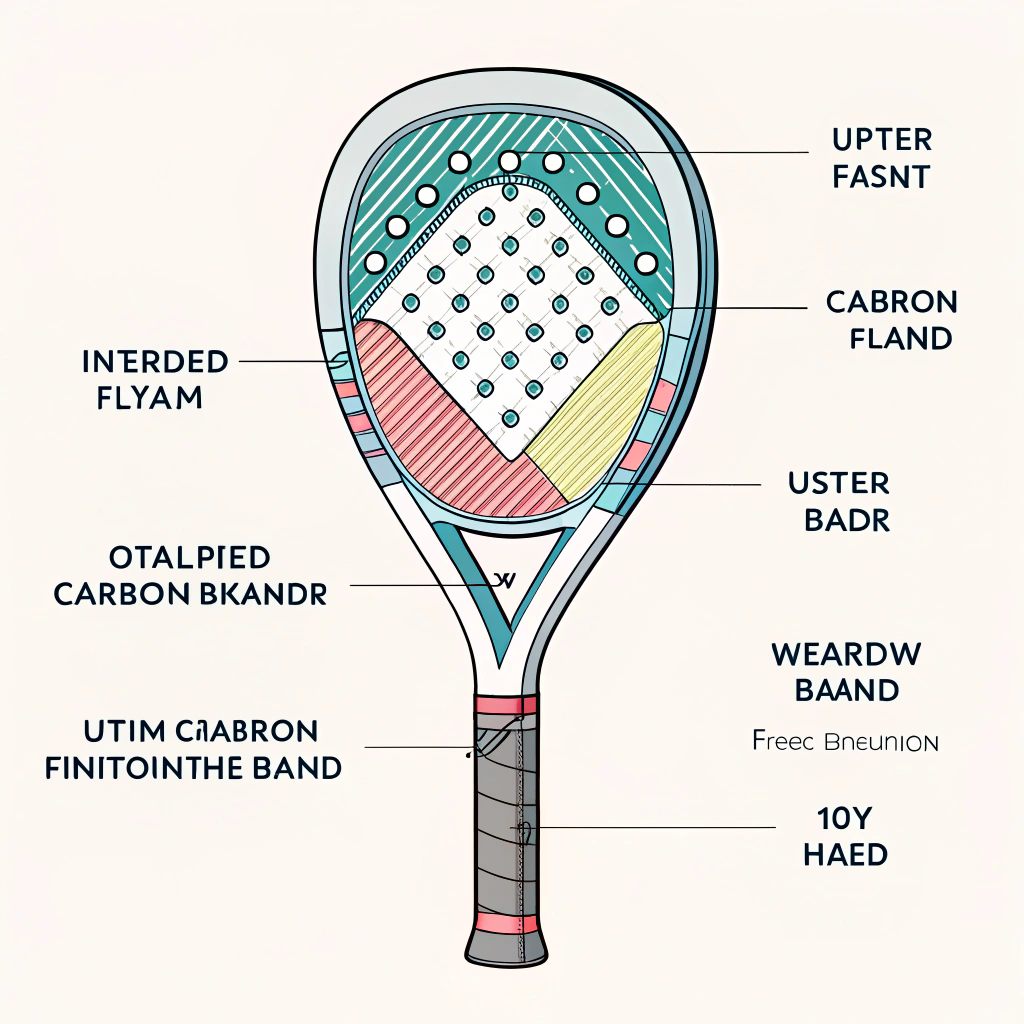
Below is a matrix combining player level, mold type, and core hardness with recommended carbon strategies NEX Padel typically proposes in OEM projects.
| Player segment | Typical style | Recommended carbon strategy (face) | Core & mold suggestions |
|---|---|---|---|
| Beginner / Recreational | Learning basics, slower swing | Full fiberglass or glass + thin 3K | Soft/medium EVA, Round mold |
| Lower‑intermediate | All‑round, needs help with depth | 12K or 3K/Glass hybrid | Medium EVA, Round or forgiving Teardrop |
| Upper‑intermediate / Advanced | Aggressive all‑round | Full 12K or 3K outer + glass sub‑layer | Medium/hard EVA, Teardrop or light Diamond |
| Advanced attacker | Strong smash, volleys | Full 3K (maybe double ply on faces) | Hard EVA, Diamond mold |
| Comfort‑focused advanced | Technical player, joint issues | 18K or 12K + fiberglass internal layer | Soft/medium EVA, Round/Teardrop for large sweet spot |
| Premium / flagship marketing | Need visual differentiation | Visible 18K (or 12K with special finish texture) | Core & mold tuned to desired brand identity (power vs control) |
-
Diamond
- Higher balance, smaller sweet spot.
- Best combined with 3K or 12K for powerful, advanced rackets.
- We often stiffen the frame to control breakage.
-
Round
- Central sweet spot, very forgiving.
- Ideal with 12K / fiberglass hybrids for comfort and control.
- Good for beginner to intermediate segments and frequent players.
-
Teardrop
- Compromise between Diamond and Round.
- Works well with 12K or 3K faces depending on target player.
- Popular all‑round choice in many collections.
From an OEM sourcing perspective, tow count choices have clear commercial implications.
- 3K: widely available, strong supply base, good pricing.
- 12K: slightly higher price; still mainstream, reliable availability.
- 18K / 24K: more expensive, smaller supply base in racket‑grade fabrics; often need larger MOQs and tighter planning.
If you aim for:
- Fast sampling + flexible MOQ → 3K and 12K are safest.
- Marketing‑driven premium SKUs → budget higher for 18K/24K raw materials and buffer extra lead times.
Because higher‑K fabrics are heavier per ply at similar gsm, you may:
- Need to remove a layer (reducing stiffness), or
- Thin the core, or
- Accept a higher final swing weight.
At NEX Padel, we typically propose a weight window (e.g. 360–370g finished, unstrung) early in the design and then tune:
- Number of carbon plies,
- Core thickness and density,
- Grip length and cap components.
All our carbon options support:
- Full custom shapes (beyond Diamond/Round/Teardrop)
- Custom colors & printing on all surfaces
- Custom Logo on hand grip and end cap
- Rough surface finishes (sand, 3D texture, or printed roughness)
For the ball line, we can extend your brand to padel balls with:
- 45% wool and 57% wool options
- Pressurized tubes ensuring stable bounce during shelf life.
Instead of only writing “I want 18K carbon,” you will get better results if your RFQ5 or brief includes:
-
Target player & segment
- Example: “Upper‑intermediate all‑round, needs comfort but still good power.”
-
Performance priorities (ranked)
- Example: “1) Comfort, 2) Control, 3) Power, 4) Durability.”
-
Mold & balance
- “Teardrop, mid balance, finished weight 365–375 g.”
-
Core hardness
- “Medium EVA, not too soft, good rebound on defensive lobs.”
-
Face material preference
- “12K carbon faces, not too hard in feel; willing to consider hybrid if needed to hit the comfort target.”
-
Frame durability
- “Strong torsion resistance, low breakage at top edge in amateur play.”
-
Price band & volume
- Example: “This is a core model; price sensitive. 2,000–5,000 pcs first season.”
From this, we can:
- Propose 3K vs 12K vs hybrid options with test data.
- Explain trade‑offs in stiffness, vibration, and durability.
- Provide samples with slight variations (e.g. 3K hard, 3K/Glass medium, 12K soft) so your team and sponsored players can choose.
If you only take a few decisions into your planning meeting, let them be these:
-
Use 3K carbon when:
- You want high control and sharp power for advanced players.
- You can pair it with appropriate cores and molds to avoid excessive harshness.
- You need reliable supply, good pricing, and proven durability.
-
Use 12K carbon when:
- You target all‑round performance and comfort for intermediates and regular club players.
- You want a premium look and feel, but not too soft.
- You still want good control with easier ball exit than 3K.
-
Use 18K (and 24K) when:
- You launch premium or niche comfort‑oriented models.
- You want a very distinctive visual carbon pattern.
- You accept higher material cost and more complex planning.
And never specify only the “K”: combine tow count with core hardness, mold, frame design, and layup structure to build a coherent story for each player level. This is where a manufacturing partner like NEX Padel can translate your marketing brief into testable layups and clear BOMs, ready for sampling and roll‑out.
Neither is universally “better”; they are different.
- 3K carbon usually gives a stiffer, crisper, and more precise feel, with higher perceived hardness and more explosive power for players who hit hard.
- 12K carbon is typically softer and more flexible, offering easier ball exit, more comfort, and a slightly smoother response.
For advanced, offensive players, 3K often works best. For intermediate or comfort‑oriented rackets, 12K is usually the safer and more versatile choice.
The “K” number indicates how many filaments are bundled into each carbon tow.
- 3K: about 3,000 filaments per bundle, forming a tighter, finer weave with a firmer feel.
- 18K: about 18,000 filaments per bundle, resulting in thicker bundles and a more open, elastic fabric.
In a padel racket, 3K tends to feel harder and more direct, while 18K tends to feel softer and more cushioned, assuming the same core and layup thickness. Overall behavior still depends heavily on EVA hardness, number of layers, and frame design.
With comparable layups and core hardness, 3K carbon feels harder than 18K carbon. The tighter 3K weave produces a stiffer impact surface with sharper feedback. 18K, with its larger bundles and more flexible fabric, usually produces a softer, more forgiving touch.
-
EVA hardness: Read to understand EVA foam durometer scales, rebound, and damping so you can tune feel, comfort, and injury risk across player segments. ↩
-
tow count: Learn how filament‑bundle size affects weave openness, stiffness, weight, visual texture, and material cost in racket design. ↩
-
prepreg: See why controlled resin content improves quality and repeatability versus wet layup, and how it impacts price, yield, and performance. ↩
-
Unidirectional (UD) carbon: Explore anisotropic properties and how UD plies tune longitudinal/torsional stiffness, durability, and frame reinforcement. ↩
-
RFQ: Get a checklist for structuring a padel‑racket RFQ that speeds quotes, clarifies specs, reduces rework, and aligns price, MOQ, and lead times. ↩
For brands: choosing the carbon grade for your own racket
If you are building a racket line, compare carbon grades on the same mould: ask your factory for samples in two grades so you can judge feel and price side by side before you commit. Custom rackets start from 50 pieces. See our custom padel racket options.