Skip to content
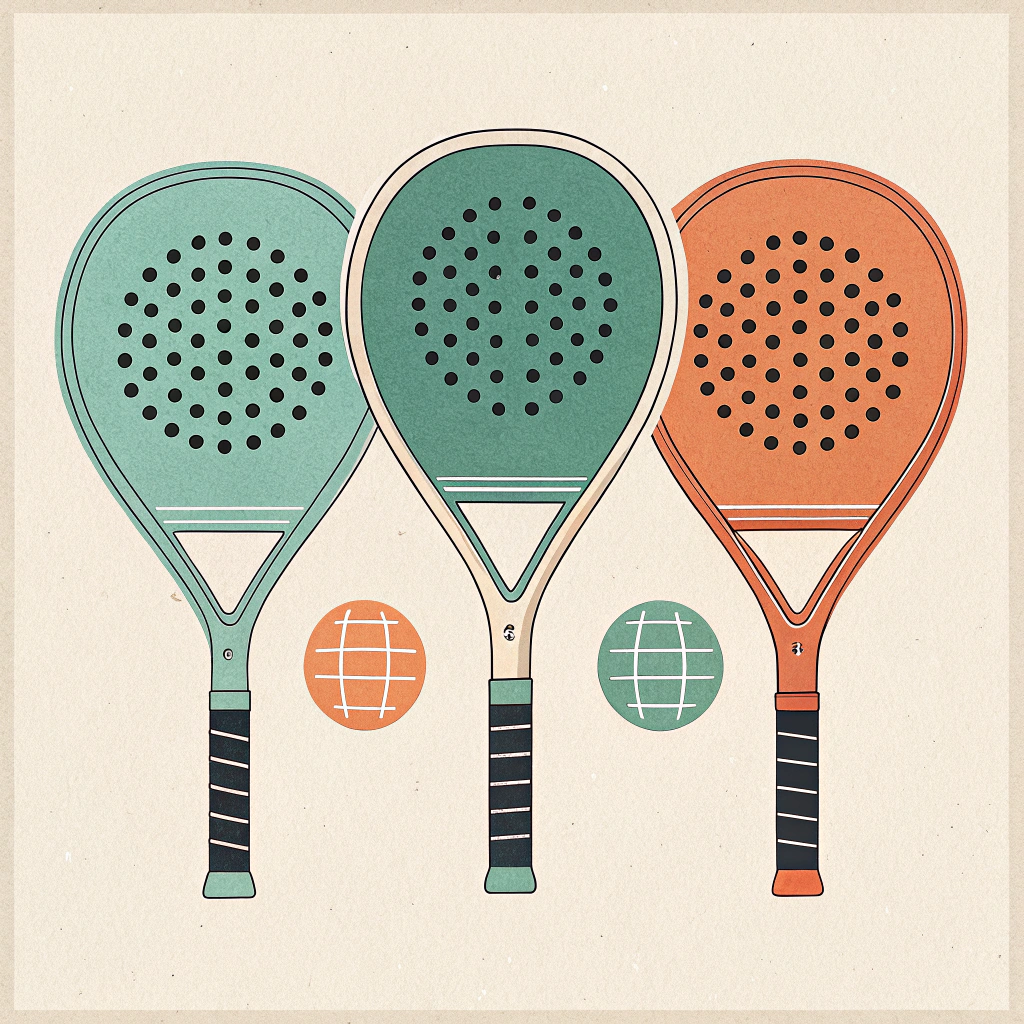
A padel racket’s construction affects accuracy and power through a combination of shape, mass distribution (weight & balance), swingweight (MOI)1, core hardness, and face material/layup. In simple terms: higher swingweight, harder core, and stiffer carbon faces increase power but reduce forgiveness, while lower swingweight, softer EVA and more fiberglass improve control and comfort but reduce maximum ball speed. For OEM specification, most adult rackets sit at 350–375 g, 38 mm thickness, and target different player levels by tuning shape (diamond/round/teardrop), carbon grade (3k/12k/18k vs fiberglass), EVA hardness, and balance point.
Most padel brand PMs and buyers start from segments, not from materials. Typical product lines:
- Entry / recreational
- Intermediate / improving club player
- Advanced / competition
- Power-oriented pro / heavy hitter
To turn those into a factory-ready brief, you need to define:
- Target weight and balance point
- Shape (diamond, round, teardrop)
- Swingweight (moment of inertia, MOI) range
- Core: EVA hardness/density and rebound
- Face and frame: fiberglass vs 3k/12k/18k carbon, layup schedule2
- Drilling pattern, surface finish, and vibration control details
- Tolerances and QC metrics that protect your brand promise
Below is a high-level mapping that many brands converge on:
| Player segment | Priority | Typical shape | Face material | Core hardness | Balance | Feel summary |
|---|---|---|---|---|---|---|
| Recreational / casual | Comfort | Round | Mostly fiberglass | Soft–medium EVA | Even / head-light | Large sweet spot, arm-friendly |
| Intermediate | Control mix | Round/Teardrop | FG + 3k/12k hybrid | Medium EVA | Even | Stability + some “free” power |
| Advanced all-round | Balanced | Teardrop | 3k or 12k carbon | Medium–hard EVA | Even / slight HH | Strong hits, still manageable |
| Power / attacking player | Power | Diamond | 12k/18k carbon | Hard EVA | Head-heavy (HH) | High ball speed, punishing mishits |
From here, the rest of the article translates “feel words” into specs you can write into your OEM brief and enforce in QC.
Shape defines sweet spot location and forgiveness.
-
Round
- Sweet spot: more central and slightly lower.
- Effect: easier timing on defensive shots, lobs, and off-center contacts.
- Accuracy: high – especially for backcourt play and blocks.
- Power: limited ceiling vs diamond; relies more on player swing speed.
-
Diamond
- Sweet spot: higher, towards the tip.
- Effect: more leverage and power in overheads and volleys close to the net.
- Accuracy: more demanding; off-center hits twist more.
- Power: high for players who can consistently hit the upper zone.
-
Teardrop
- Sweet spot: between round and diamond, slightly above center.
- Effect: versatile; often used for “all-round” or intermediate/advanced models.
- Accuracy vs power: balanced profile; easier than diamond, stronger than most rounds.
A simple decision rule for your line:
- Build control/comfort SKUs around round.
- Build hero power SKUs around diamond.
- Use teardrop to cover most club and competitive players.
Two rackets can have the same static weight but feel completely different due to balance and swingweight.
- Static weight (g): mass of the racket, typically 350–375 g for adult rackets.
- Balance point (mm from butt): head-light (~255–265 mm), even (~265–270 mm), head-heavy (~270–280+ mm).
- Swingweight / MOI: resistance to changing swing speed or direction; usually measured on a swingweight machine.
Cause–effect:
-
Higher swingweight and more head-heavy:
- Pros: more power on serves, smashes, and high volleys; more stability vs heavy balls.
- Cons: slower preparation, more fatigue, higher demand on shoulder and elbow.
- Impact: better for advanced attackers, worse for beginners.
-
Lower swingweight and more head-light:
- Pros: faster maneuvering, easier for defensive play and quick net reactions.
- Cons: less “free” power; ball speed depends more on technique.
- Impact: better for control and comfort lines.
A practical OEM spec block often looks like:
- Static weight target: 365 g (unstrung, without overgrip, ±7 g tolerance)
- Balance point target: 270 mm from butt (±5 mm)
- Swingweight target: 130–135 kg·cm² (specify machine/method if you have one)
At NEX Padel, we can tune swingweight not only via balance and static weight but also by:
- Adjusting layup thickness around the top edge.
- Using different bumper/edge guard mass (thicker, denser bumpers add MOI).
- Choosing handle insert materials and grip build-up.
Face construction is one of the strongest levers you have for power, control, and durability.
-
Fiberglass composite
- Properties: more flexible, higher elongation, lower stiffness.
- Feel: soft, comfortable, higher dwell time.
- Performance: easier depth on slow swings, but tops out at lower power.
- Best for: beginners, frequent players with arm issues, comfort-driven models.
-
3k carbon fiber
- Tighter weave of small tows (3000 filaments).
- Properties: stiffer than fiberglass but still somewhat compliant.
- Feel: controlled, crisp, not overly harsh.
- Good for: all-round rackets; step-up from fiberglass.
-
12k carbon fiber
- Larger tow size, more open weave vs 3k.
- Properties: stiffer and stronger; quicker energy return.
- Feel: more direct, “lively”, slightly raw.
- Good for: advanced players seeking power without going extreme.
-
18k carbon fiber
- Even larger tow size and coverage.
- Properties: high stiffness, fast rebound, high torsional rigidity.
- Feel: powerful, firm, punishing if technique is off.
- Good for: high-level, aggressive players.
While tennis uses RA stiffness index3 widely, padel brands can approximate similar metrics by measuring deflection and torsional stiffness of the frame/face. Higher RA / torsional stiffness usually means:
- More efficient energy transfer → more power.
- Smaller effective sweet spot → lower forgiveness.
- Sharper vibration signature → can feel harsh if core and layup are not tuned.
To balance things, many brands choose hybrids:
- Outer layer: carbon (3k/12k/18k)
- Under layer: fiberglass or softer carbon
- Core: medium EVA, tuned with density and thickness
At NEX Padel we regularly build:
- Full fiberglass faces for comfort models.
- FG + 3k hybrids for intermediates.
- 3k/12k/18k full-carbon faces for high-performance SKUs, tuning stiffness via ply count and resin ratios.
The EVA core is the heart of padel racket behavior. Key variables:
- Hardness / density (often correlated).
- Core thickness (within the 38 mm frame constraint).
- Rebound (Coefficient of Restitution (COR)4) at different impact speeds.
-
Softer EVA
- More deformation at impact, longer dwell time.
- Feel: plush, “trampoline-like” at low–medium speed.
- Performance: easy depth from backcourt, more control on fast balls, better comfort.
- Risk: loss of precision and control in very fast, aggressive swings (ball can launch high).
-
Harder EVA
- Less deformation, faster energy return at high speeds.
- Feel: firm, direct, less dwell time.
- Performance: high power ceiling for smashes, precise for strong players.
- Risk: demanding for beginners, harsher on joints, less help on slow shots.
For OEM briefs, it helps to specify:
- EVA Shore hardness5 range (e.g., 15–20 for soft; 20–25 for medium; 25+ for hard, depending on supplier’s scale).
- Desired COR ranges:
- Low-speed COR (e.g., 3–5 m/s impacts): for comfort and easy depth.
- High-speed COR (e.g., 15–20 m/s): for smashes and aggressive play.
If you do not work with COR numbers today, you can specify in words and let a manufacturer like NEX Padel translate:
- “Soft core for easy depth, comfortable on elbow, oriented to beginners.”
- “Medium core, balanced control and power, main line for club players.”
- “Hard core for maximum power, low dwell, for advanced attackers.”
Within the 38 mm frame thickness, hole layout has a visible effect:
- Denser central drilling
- Increases trampoline effect in center.
- Can slightly soften feel and enlarge sweet spot.
- More holes towards tip
- Further activates upper area; useful for diamond shapes.
- Can reduce structural stiffness; needs stronger layup around top edge.
You can specify:
- Hole diameter range (often 9–13 mm).
- Total hole count (e.g., 50–70 holes).
- Distribution emphasis: central, spread, or tip-biased.
At NEX Padel we prototype different patterns for the same layup to show how the effective sweet spot moves and how stability changes.
Surface finish affects spin and ball interaction:
- Smooth gloss or matte
- Neutral, predictable; focus is on core and layup feel.
- Sand finish / textured
- Increases friction, helping slice and topspin control.
- Can feel slightly firmer on contact.
You can define:
- Roughness level (light / medium / aggressive).
- Whether texture is painted, embedded, or via film.
Even with stiff carbon and hard EVA, you can manage vibration through:
- Layup schedule: placing a softer fiberglass or lower-modulus carbon ply internally.
- Resin choice and ratio: slightly more flexible systems soften shock (within durability limits).
- Handle system: foam inserts, vibration-damping elements, or specific handle construction.
Spec options to include:
- “Prioritize vibration reduction for this line; accept slight weight increase if needed.”
- “Maintain stiffer, direct feel; minimize added damping components.”
Below is a practical specification matrix you can adapt into your OEM brief.
| Parameter | Recommended range |
|---|---|
| Shape | Round |
| Static weight | 355–365 g (±7 g) |
| Balance | 260–268 mm (even to slightly head-light) |
| Swingweight (MOI) | ~120–130 kg·cm² |
| Face material | Full fiberglass or FG outer + FG inner |
| Core | Soft EVA |
| Surface | Smooth or light texture |
| Drilling | Central emphasis, consistent sweet spot |
| Player type | New players, casual club users, rental racks |
Expected result: large sweet spot, low vibration, easy depth with slow/short swings.
| Parameter | Recommended range |
|---|---|
| Shape | Round or Teardrop |
| Static weight | 360–370 g (±7 g) |
| Balance | 265–272 mm (even) |
| Swingweight (MOI) | ~125–135 kg·cm² |
| Face material | FG + 3k/12k carbon hybrid |
| Core | Medium EVA |
| Surface | Light–medium texture |
| Drilling | Slightly expanded sweet spot, balanced distribution |
| Player type | Regular club players, improving intermediates |
Expected result: mix of control, stability, and “usable” power with reasonable comfort.
| Parameter | Recommended range |
|---|---|
| Shape | Teardrop or Diamond |
| Static weight | 365–375 g (±7 g) |
| Balance | 270–280 mm (head-heavy) |
| Swingweight (MOI) | ~135–145 kg·cm² (or higher for power specialists) |
| Face material | Full 12k or 18k carbon |
| Core | Medium–hard or hard EVA |
| Surface | Medium–aggressive texture |
| Drilling | Tip-biased or all-court pattern, strong top edge |
| Player type | Competitive, demanding more power and precision |
Expected result: high ball speed potential, precise for good technique, less forgiving.
A strong padel racket brief should convert your marketing and player-level concepts into quantifiable specs and testable tolerances.
-
Target player profile & positioning
- Level (beginner / club / advanced / pro).
- Style (defensive, all-round, attacking).
- Priority (power vs control vs comfort).
-
Geometry
- Shape (round/teardrop/diamond or custom).
- Overall thickness (usually 38 mm; specify if otherwise).
- Head size outline and drilling layout preference.
-
Mass & balance
- Static weight target and tolerance.
- Balance point (mm from butt) and tolerance.
- Any swingweight target if you use MOI.
-
Construction
- Face materials and sequence (e.g., outer 12k carbon / inner FG).
- Frame rails: carbon grade and ply count.
- EVA core hardness/density target.
- Edge protector / bumper material and approximate mass.
-
Surface and graphics
- Texture level.
- Color and print complexity.
- Logo placements for custom printing, including on hand grip and butt cap.
-
Performance expectations
- Prioritized attributes: “Comfort over power”, “Maximum ball speed”, etc.
- Field-testing criteria: feedback from your test team (e.g., “block stability vs heavy balls”, “lob depth”).
-
QC standards
- Weight range per SKU.
- Balance tolerance.
- Visual QA (paint, print alignment).
- Impact resistance / durability expectations.
Based in Jiaxing, Zhejiang, NEX Padel combines:
- Broad material coverage: from full fiberglass to 3k/12k/18k carbon.
- Fast, iterative sampling so you can A/B test shapes, cores, and balances quickly.
- Stable OEM/ODM production for brands like Hirostar, Reebok, and Starvie, with tight QC and consistent batches.
We help you:
- Convert high-level product ideas into detailed layup schedules and measurable specs.
- Tune resin ratios and curing to achieve your desired stiffness and durability.
- Co-develop custom shapes, drilling patterns, and finishes.
- Extend your offering with padel balls (45% and 57% wool, pressurized tubes) under your logo, with QC monitored by us.
If you share your line map (e.g., “3-level pyramid: control – all-round – power”), we can propose a spec ladder across those levels and then validate it through both lab metrics and on-court testing.
When the score in a game reaches 40-40, it is called deuce. In many padel competitions a golden point rule is used: instead of playing advantage and multiple deuces, the next point decides the game. The receiving pair chooses which side will receive the serve, and whoever wins that single rally wins the game. This keeps matches faster and adds tension to key points.
Power in padel comes from a combination of technique and equipment. On the technique side, players should use a smooth, full swing, rotate the hips and torso, and engage the core so that racket-head speed is as high as possible at impact. On the equipment side, a stiffer, head-heavier racket with a harder core can increase ball speed for players who have the strength and timing to control it.
More expensive padel rackets usually use higher-grade carbon, more complex layups, and tighter quality control, which can improve power, precision, and durability. However, they do not automatically make a player better. For beginners or occasional players, a mid-range, comfortable racket is often more suitable. Advanced players who already have solid technique are the ones who benefit most from premium constructions and higher prices.
-
swingweight (MOI): Read to understand what moment of inertia measures, how it’s tested on swingweight machines, and how specifying MOI ranges translates to on-court feel, power, and maneuverability in OEM briefs. ↩
-
layup schedule: Learn how ply sequence, orientation, fabric grade, and resin ratios control stiffness, durability, and vibration—and how to document them for repeatable factory builds and QC. ↩
-
RA stiffness index: See how RA is defined and measured in tennis frames, ways to approximate it for padel (deflection/torsion rigs), and how higher RA impacts power, feel, and forgiveness. ↩
-
Coefficient of Restitution (COR): Get practical test setups and speed bands for measuring rebound, so you can target low- and high-speed COR windows that match your player segment. ↩
-
Shore hardness: Clarifies Shore A/C scales for EVA foams, how hardness correlates to density and feel, and how to set supplier ranges/tolerances for consistent cores across batches. ↩