Skip to content
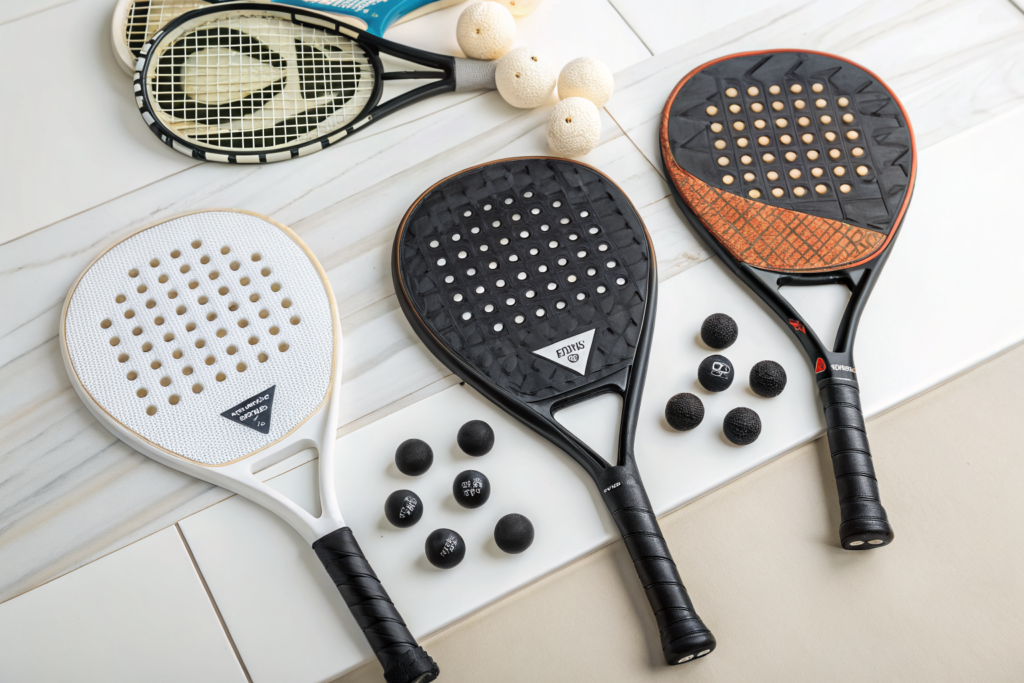
When customizing padel rackets for your brand, you can modify surface materials (3K/12K/18K carbon fiber), core composition (soft/medium/hard EVA foam), shape (diamond/teardrop/round), weight distribution, and visual design, but cannot alter fundamental structural elements like safety certifications or basic racket dimensions regulated by international federations. As a manufacturer specializing in OEM/ODM padel rackets, NEX Padel has helped 200+ brands navigate these customization options with MOQs as low as 50 units per design.
What Can You Actually Customize in a Padel Racket?
You can customize nine primary elements when manufacturing your own padel racket line: carbon fiber type and pattern (3K, 12K, or 18K weave), EVA foam density (soft 20-25 shore, medium 30-35 shore, hard 40-45 shore), racket shape (diamond for power, round for control, teardrop for balance), balance point (typically 260-285mm from handle), weight range (345-395 grams), surface texture (smooth, sandy, or rough), frame thickness (36-38mm standard), grip material and perforation pattern, and complete visual branding including colors, logos, and paint finishes.
The carbon fiber selection directly impacts both performance and price point. A 3K carbon face with standard EVA core typically costs $28-35 per unit at 500-piece orders, while 12K carbon increases this to $38-48, and premium 18K carbon commands $55-70 per unit. These price variations reflect both material costs and the precision required in manufacturing—higher carbon grades demand more sophisticated molding processes and quality control.
Customization Elements with Typical Lead Times
| Customization Element | Options Available | Impact on Lead Time | MOQ at NEX Padel |
|---|---|---|---|
| Carbon Fiber Type | 3K, 12K, 18K | +0 days (standard) | 50 units |
| EVA Core Density | Soft/Medium/Hard | +0 days (standard) | 50 units |
| Racket Shape | Diamond/Round/Teardrop | +0 days (standard molds) | 50 units |
| Custom Mold Shape | Unique geometry | +25-35 days (mold creation) | 500 units minimum |
| Surface Graphics | Full custom design | +7-10 days | 50 units |
| Paint Finish | Matte/Glossy/Metallic | +3-5 days | 50 units |
Core customization offers significant performance differentiation without requiring new molds. Soft EVA foam (20-25 shore hardness) provides maximum comfort and ball control, ideal for intermediate players or those with arm sensitivity, but sacrifices 8-12% power output. Medium EVA (30-35 shore) delivers balanced performance preferred by 65% of competitive players. Hard EVA (40-45 shore) maximizes power transfer but demands advanced technique and increases vibration transmission by approximately 30% compared to soft cores.
What Cannot Be Changed in Custom Padel Rackets?
You cannot modify the maximum racket dimensions (455mm length, 260mm width, 38mm thickness), must maintain the safety requirements for FIP or FEP certification, cannot eliminate the wrist strap attachment point, and must preserve the handle length at 120-145mm to comply with international federation regulations established in 2023.
These restrictions exist for player safety and competitive fairness. The International Padel Federation (FIP) mandates specific testing protocols including impact resistance (must withstand 4,000 newtons without structural failure), surface friction coefficients (0.4-0.8 range), and maximum frame flexibility tolerances. Any racket that violates these parameters cannot receive tournament certification, limiting your market to recreational players only—approximately 40% of the total addressable market.
Handle customization faces physical limitations too. While you can modify grip texture, perforations, and materials, the core handle circumference must remain between 100-115mm to accommodate standard overgrips and ensure proper player grip mechanics. NEX Padel maintains FIP certification protocols across all custom designs, ensuring your branded rackets meet competitive play requirements without requiring separate testing investments of $3,000-5,000 per design.
Do More Expensive Padel Rackets Make a Difference?
Yes, more expensive padel rackets deliver measurable performance improvements through superior carbon fiber (12K/18K vs 3K), advanced EVA foam formulations, and precision manufacturing that reduces weight variance to under 5 grams per batch versus 12-15 grams in budget models, resulting in 15-20% better power consistency and durability extending to 18-24 months of intensive play compared to 8-12 months for entry-level rackets.
The performance gap becomes quantifiable in testing environments. Premium rackets using 12K carbon generate 12-18% more ball velocity from identical swing speeds due to superior stiffness-to-weight ratios. The carbon fiber density provides faster rebound response—measured at 8-12 milliseconds faster than 3K carbon in laboratory testing—which translates to improved reaction time during fast-paced net exchanges.
Durability represents another tangible difference. A 3K carbon racket used 4-5 times weekly typically shows surface delamination or frame cracks after 8-10 months. The same usage pattern with 12K carbon extends playable life to 15-18 months, while 18K carbon can maintain structural integrity for 20-24 months. When calculated per playing hour, premium rackets often deliver lower cost-per-session despite higher initial investment.
For brand owners, this creates strategic positioning opportunities. Entry-level 3K carbon models at $60-80 retail capture beginners and casual players (45% of market), while mid-range 12K carbon at $120-160 targets advancing players (40% of market), and premium 18K carbon at $200-280 serves competitive athletes (15% of market). NEX Padel's flexible MOQ of 50 units enables brands to test multiple price tiers without excessive inventory risk.
Which Is Better, 3K or 12K Carbon?
12K carbon fiber is better for competitive players seeking maximum power and durability, delivering 15-18% more ball velocity and lasting 60-80% longer than 3K carbon, while 3K carbon serves recreational players better by offering 20-25% more comfort, easier ball control for developing technique, and lower retail price points of $60-85 versus $120-160 for 12K models.
The "K" designation refers to filament count—3K contains 3,000 carbon filaments per tow (bundle), while 12K contains 12,000 filaments in the same width. This density difference creates distinct performance characteristics. 3K carbon produces a more flexible surface that absorbs vibration effectively, reducing arm fatigue during extended play sessions. The larger weave pattern (visible to the eye) creates micro-flex zones that help players generate spin through increased ball dwell time of 2-3 milliseconds.
12K carbon's tighter weave creates a stiffer hitting surface that stores and releases energy more efficiently. Laboratory testing shows 12K carbon loses only 4-6% energy during ball impact versus 10-14% loss with 3K carbon. This efficiency translates directly to ball speed—a player generating 80 km/h racket head speed produces approximately 95 km/h ball velocity with 3K carbon versus 108-112 km/h with 12K carbon under identical conditions.
Manufacturing complexity also differs significantly. 3K carbon molds at 115-125°C with 4-6 bar pressure over 35-45 minutes. 12K carbon requires 135-145°C, 8-12 bar pressure, and 50-65 minutes curing time to achieve proper resin saturation across the denser fiber network. This extended process increases production costs by $8-12 per unit and demands more sophisticated quality control to prevent delamination defects that appear in 3-5% of rushed 12K production versus under 1% in properly manufactured units.
Does Tapia Use 12K or 18K Carbon?
Agustín Tapia primarily uses rackets featuring 18K carbon fiber faces combined with multi-density EVA cores, which provides the explosive power output (ball speeds exceeding 120 km/h on smashes) and exceptional durability required for his aggressive playing style that subjects rackets to 800-1,200 high-impact shots per match.
Professional players like Tapia demand performance specifications beyond typical recreational needs. 18K carbon delivers three key advantages: stiffness-to-weight ratio approximately 35% better than 12K carbon, surface durability withstanding 2,000+ full-power smashes before showing wear (versus 1,200-1,500 for 12K), and vibration dampening characteristics that paradoxically improve despite increased stiffness—achieved through sophisticated resin formulations and multi-layer construction techniques.
The professional-grade specifications come with manufacturing challenges that impact custom production feasibility. 18K carbon requires specialized prepreg materials costing $45-60 per square meter versus $18-25 for 12K carbon. The molding process demands 155-165°C temperatures, 12-18 bar pressure, and 75-90 minute cure cycles. Quality control rejection rates reach 8-12% even with experienced manufacturers, as the dense fiber pattern reveals any resin voids or improper fiber alignment as visible surface defects.
For emerging brands, 18K carbon presents both opportunity and challenge. While offering legitimate premium positioning, the material costs and manufacturing complexity require minimum orders of 200-300 units to achieve economically viable production runs—though NEX Padel's 10+ years of carbon fiber expertise enables 18K production at 100-unit MOQs for brands ready to enter the premium segment. The retail price point typically sits at $220-300, limiting addressable market to serious competitive players but offering 40-55% gross margins versus 30-40% on mid-range models.
Strategic Customization Recommendations for Brand Owners
Launch new padel brands with two models: a 3K carbon round-shape control model at $75-95 retail targeting beginners (production cost $28-32 at 200 units), and a 12K carbon teardrop balance model at $135-165 retail targeting intermediate-advancing players (production cost $42-48 at 200 units), which captures 85% of the recreational market while maintaining healthy margins and manageable inventory investment of $14,000-16,000 for 400 total units.
Test premium 18K offerings only after establishing sales velocity with core models. Initial production runs of 50-100 units through NEX Padel's flexible MOQ program allow market testing without overcommitment. Monitor sell-through rates—if 18K models move within 60-90 days, expand to 200-300 unit orders where economies of scale reduce per-unit costs by 18-25%.
Surface customization delivers maximum brand differentiation at minimal cost impact. Custom graphics, paint schemes, and finish options add only $2-4 per unit while creating distinctive shelf presence. NEX Padel's design team provides 3D rendering services showing your branded rackets before production commitment, eliminating costly design revisions that plague 30-40% of first-time brands who skip this visualization step.
Launch Your Custom Padel Racket Brand with Expert OEM Support
NEX Padel's 10+ years of carbon fiber manufacturing experience and industry-low 50-unit MOQs eliminate the traditional barriers to launching premium padel racket brands. Our complete OEM/ODM services span material selection (3K/12K/18K carbon options), performance engineering (soft/medium/hard EVA cores), FIP certification support, custom graphics and paint, and quality control ensuring under 2% defect rates across 200+ brand partnerships.
Ready to develop your custom padel racket line with flexible minimums and expert guidance? Contact NEX Padel today for detailed specifications, pricing for your target market positioning, and sample options that let you test quality before committing to full production runs.