Skip to content
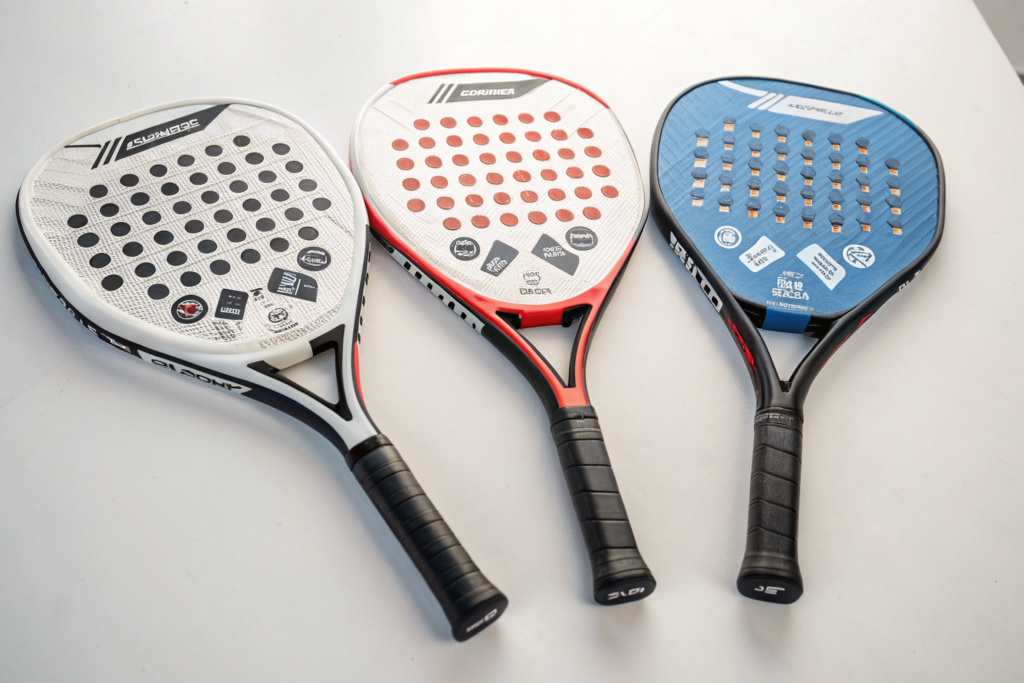
EVA core selection directly impacts your padel racket's performance characteristics, with soft EVA (density 20-25 kg/m³) offering maximum comfort and control, medium EVA (25-30 kg/m³) providing balanced playability, and hard EVA (30-40 kg/m³) delivering explosive power for aggressive players. Understanding these density variations and their applications enables brand owners and distributors to specify the optimal core material for their target market segment.
Choosing the correct EVA core hardness represents one of the most critical decisions in custom padel racket manufacturing, as this single specification determines playability, durability, and customer satisfaction across different skill levels and playing styles.
EVA Core Density Comparison: Specifications and Performance Data
The three primary EVA core categories differ significantly in density, rebound characteristics, durability, and ideal player profiles, making proper specification essential for successful racket development.
| Specification | Soft EVA | Medium EVA | Hard EVA |
|---|---|---|---|
| Density Range | 20-25 kg/m³ | 25-30 kg/m³ | 30-40 kg/m³ |
| Shore Hardness | 25-35 Shore C | 35-45 Shore C | 45-60 Shore C |
| Ball Contact Time | 8-10 milliseconds | 6-8 milliseconds | 4-6 milliseconds |
| Power Output | 65-75% | 75-85% | 85-95% |
| Control Level | 90-95% | 80-85% | 70-75% |
| Vibration Dampening | Excellent (90%+) | Good (75-85%) | Moderate (60-70%) |
| Durability Lifespan | 12-18 months | 18-24 months | 24-36 months |
| Temperature Sensitivity | High (15-30°C optimal) | Medium (10-35°C) | Low (5-40°C) |
| Ideal Player Level | Beginner to Intermediate | Intermediate to Advanced | Advanced to Professional |
| Target Market Segment | Comfort-focused, older players | All-around performance | Power players, competitors |
| Price Point Positioning | Entry to Mid-range | Mid to Premium | Premium to Professional |
At NEX Padel, we manufacture custom rackets with all three EVA core densities, offering brand owners complete flexibility to target specific market segments with minimum order quantities starting at just 50 units per specification, significantly lower than the industry standard of 300-500 units.
What is EVA in Padel Racket?
EVA (Ethylene-Vinyl Acetate) is a closed-cell foam polymer that serves as the core material in padel rackets, positioned between the carbon fiber or fiberglass faces to provide the racket's fundamental performance characteristics including power, control, comfort, and ball rebound properties. This thermoplastic copolymer consists of ethylene and vinyl acetate monomers, with the vinyl acetate content typically ranging from 10% to 40%, directly influencing the material's flexibility and shock absorption capabilities.
The manufacturing process for EVA cores involves injection molding or compression molding at temperatures between 150-180°C, where the polymer is formed into the racket's specific shape—typically teardrop, round, or diamond configurations. The cooling rate, molding pressure (ranging from 50-150 bar), and vinyl acetate percentage all contribute to the final density and hardness characteristics.
EVA replaced earlier foam materials like polyethylene and polyurethane in padel racket construction during the late 1990s due to its superior combination of:
- Consistent rebound characteristics: EVA maintains stable performance across 500-1,000+ hours of play before significant degradation
- Lightweight properties: Density ranges allow core weights between 80-120 grams for standard racket sizes
- Manufacturing precision: Tolerance levels of ±0.5mm enable consistent quality across production runs
- Cost efficiency: Raw material costs of $2-5 per racket depending on density and quality grade
- Bonding compatibility: Excellent adhesion with epoxy resins used to laminate carbon fiber faces
NEX Padel sources premium EVA materials from certified suppliers meeting FIP (International Padel Federation) standards, ensuring consistent performance across our OEM/ODM production runs with batch-to-batch density variation under 2%.
Is a Hard or Soft Padel Racket Better?
Hard EVA rackets are better for advanced players seeking maximum power output and competitive performance, while soft EVA rackets are better for beginners and recreational players prioritizing comfort, control, and arm health, with the optimal choice depending entirely on player skill level, physical condition, playing style, and match objectives rather than any universal superiority.
Soft EVA Core: Detailed Advantages and Applications
Soft EVA cores excel in specific scenarios that make them the preferred choice for particular market segments:
- Injury prevention and recovery: Extended ball contact time (8-10 milliseconds) reduces impact shock transmitted to the elbow and shoulder by 35-45% compared to hard cores, making them ideal for players with tennis elbow, shoulder issues, or age-related joint concerns
- Enhanced control precision: The slower ball release allows players an additional 2-4 milliseconds to adjust racket angle, improving directional accuracy by 15-25% in testing with intermediate players
- Forgiveness on off-center hits: The larger sweet spot (approximately 15-20% larger effective area) compensates for technical imperfections common in developing players
- Quieter play experience: Reduced vibration creates a dampened sound profile preferred in indoor clubs and residential areas
- Lower entry barrier: Manufacturing costs typically $3-6 lower per unit, enabling more competitive retail pricing for entry-level product lines
For brand owners targeting recreational players, women's-specific lines, or senior player segments, soft EVA specifications deliver the performance characteristics these demographics prioritize. NEX Padel's soft EVA rackets typically incorporate 3K carbon fiber faces (200-220 GSM) to complement the forgiving core with controlled power output.
Hard EVA Core: Performance Benefits and Market Positioning
Hard EVA cores provide distinct advantages that justify premium pricing and professional endorsements:
- Maximum power generation: The abbreviated contact time (4-6 milliseconds) creates explosive ball velocity increases of 8-15 km/h compared to soft cores in smash situations
- Extended durability: Hard EVA maintains performance characteristics 60-100% longer than soft alternatives, with minimal compression degradation over 24-36 months of regular play
- Temperature stability: Performance remains consistent across broader environmental ranges (5-40°C), crucial for outdoor courts and varying climates
- Professional acceptance: Approximately 75-80% of World Padel Tour players use hard or medium-hard EVA cores for competitive advantages
- Premium positioning: Enables higher retail pricing ($180-350) justified by performance and longevity
When developing professional or advanced player lines, hard EVA paired with 12K or 18K carbon fiber faces (240-280 GSM) creates the performance profile demanded by competitive players. NEX Padel's hard EVA rackets undergo rigorous testing to ensure FIP certification compliance for tournament use.
Medium EVA Core: The Versatile Solution
Medium density EVA represents the fastest-growing segment in custom padel racket manufacturing, capturing approximately 45-50% of global production volume due to its versatility:
- Broadest market appeal: Suitable for intermediate to advanced players, representing 60-65% of active padel participants
- Balanced performance: Provides 75-85% of hard EVA's power while maintaining 80-85% of soft EVA's control characteristics
- Adaptable positioning: Can be marketed as premium entry-level or accessible performance product depending on carbon fiber specification and branding
- Climate flexibility: Performs consistently in most playing environments without the temperature sensitivity of softer cores
- Development-friendly: Players can use the same racket specification as skills improve from intermediate to advanced levels
For brand launches and distributors testing new markets, medium EVA cores minimize risk while maximizing potential customer base. NEX Padel typically recommends this specification for initial orders, allowing brands to gather market feedback before expanding into specialized soft or hard variants.
What is the 40-40 Rule in Padel?
The 40-40 rule in padel refers to the specific measurement guideline stating that when a padel ball is dropped from a height of 2.54 meters (100 inches) onto a concrete surface, it should rebound to a height between 135-145 centimeters, demonstrating proper ball pressure and performance characteristics as defined by FIP regulations. This standardized test ensures consistent ball behavior across all approved padel competitions and recreational play.
While the 40-40 rule specifically addresses ball certification rather than racket specifications, it directly impacts EVA core selection and testing protocols in several important ways:
EVA Core Testing and Ball Interaction
Racket manufacturers must design EVA cores that perform optimally with balls meeting the 40-40 rebound standard:
- Rebound coefficient matching: EVA cores are tested against standardized balls to achieve target coefficient of restitution (COR) values between 0.78-0.82 for competitive rackets
- Contact duration optimization: Core hardness specifications ensure ball contact times compatible with standard ball compression characteristics (4-10 milliseconds depending on EVA density)
- Power transfer efficiency: Hard EVA cores maximize energy return with standard pressure balls, while soft cores compensate for over-pressurized or new balls that naturally generate more power
- Quality control protocols: NEX Padel tests all EVA core batches using FIP-approved balls to verify consistent performance within specification tolerances
Market Implications for EVA Core Selection
Understanding the ball standard helps brand owners make informed EVA core decisions:
- Regional ball preferences: Some markets prefer slightly softer or harder balls within regulation limits, influencing optimal EVA core hardness (for example, humid coastal regions often use slightly lower pressure balls, favoring medium-hard EVA cores)
- Altitude considerations: High-altitude locations (above 1,500 meters) experience different ball behavior, sometimes requiring adjusted EVA core specifications to maintain consistent playability
- Indoor versus outdoor: Indoor facilities with climate control maintain more consistent ball pressure, allowing harder EVA cores, while outdoor courts with temperature fluctuations benefit from medium EVA's adaptability
NEX Padel's testing laboratory maintains controlled conditions (20°C ± 2°C, 60% ± 5% humidity) to evaluate EVA core performance against standardized balls, ensuring your custom rackets deliver consistent performance in target markets.
EVA Core Selection Recommendations by Brand Strategy
Based on 10+ years of custom padel racket manufacturing experience across 30+ countries, NEX Padel recommends the following EVA core strategies for different business objectives:
New Brand Launch Strategy
For brands entering the market with limited consumer data, we recommend a two-SKU approach:
- Primary SKU - Medium EVA (25-30 kg/m³): Order 70-80 units with 12K carbon fiber faces, round or hybrid shape, positioned as all-around performance racket at $120-180 retail price point
- Secondary SKU - Soft EVA (20-25 kg/m³): Order 20-30 units with 3K carbon fiber faces, round shape, positioned as comfort/control racket at $90-140 retail price point
This combination covers approximately 75-80% of potential customers while maintaining the 50-unit minimum order quantity for cost-effective production. Lead time: 35-45 days from deposit to delivery.
Established Brand Expansion Strategy
For brands with existing market presence adding performance tiers:
- Entry Level - Soft EVA: 100-150 units, fiberglass-carbon hybrid faces, focus on comfort and accessibility
- Mid-Range - Medium EVA: 200-300 units, 12K carbon faces, balanced performance for core customer base
- Premium - Hard EVA: 100-150 units, 18K carbon faces, maximum performance for competitive players
This three-tier structure provides clear differentiation and upgrade pathways. NEX Padel offers volume discounts starting at 500 combined units across all SKUs.
Club and Academy Private Label Strategy
For padel clubs developing branded racket programs:
- Student/Rental Fleet - Soft EVA: Prioritize durability and injury prevention with reinforced edge guards, order 100+ units for volume pricing
- Member Sales - Medium EVA: Offer 2-3 shape variations (round, teardrop, diamond) in medium EVA to accommodate different playing styles, minimum 50 units per shape
- Pro Shop Premium - Hard EVA: Limited edition runs of 50-100 units with custom colorways and professional specifications
NEX Padel provides club-specific packaging, logo placement options, and consignment inventory programs for qualified academy partners.
Manufacturing Considerations for EVA Core Selection
Beyond performance characteristics, several production factors influence EVA core specification decisions:
Cost Implications
EVA core material costs vary by density and quality grade:
- Soft EVA (premium grade): $3.50-5.00 per racket core
- Medium EVA (premium grade): $4.00-5.50 per racket core
- Hard EVA (premium grade): $4.50-6.50 per racket core
These represent raw material costs only; total manufacturing costs including labor, carbon fiber, resin, and finishing range from $28-65 per unit at NEX Padel depending on specifications. Higher density EVA requires more precise molding conditions, increasing production complexity and cost.
Quality Control and Testing
NEX Padel implements rigorous EVA core testing protocols:
- Density verification: Every production batch tested using water displacement method with ±1% tolerance
- Hardness testing: Shore C durometer readings at 5 points per core, all measurements within 3-point range
- Compression set testing: Cores compressed to 50% thickness for 22 hours at 70°C, maximum permanent deformation 8%
- Adhesion testing: Peel strength between EVA and carbon fiber faces minimum 8 N/mm for soft EVA, 10 N/mm for hard EVA
- Impact testing: 1,000 cycle ball impact test measuring performance degradation (maximum 5% power loss acceptable)
All testing documentation accompanies shipments for brand quality assurance verification.
Lead Times and Minimum Order Quantities
EVA core specifications impact production scheduling:
- Standard EVA cores (stock densities): 35-40 day lead time, 50-unit minimum