Skip to content
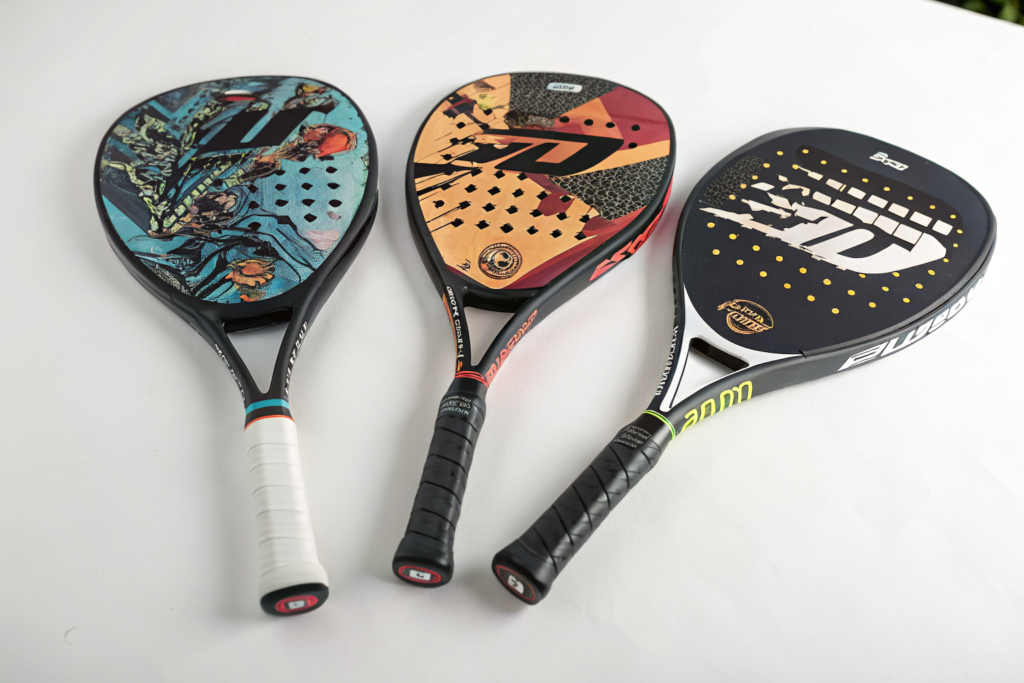
UV printing, screen printing, and hot stamping are three distinct padel racket customization methods, each with different durability, cost structures, and visual capabilities. The choice between them depends on your brand's budget, MOQ requirements, design complexity, and desired finish quality. In this guide, we'll compare these printing technologies head-to-head so you can make an informed decision for your padel racket brand.
Padel Racket Printing Methods: Quick Comparison
Before diving into details, here's a comprehensive comparison of the three primary printing methods used in professional padel racket manufacturing:
| Method | UV Printing | Screen Printing | Hot Stamping |
|---|---|---|---|
| Initial Setup Cost | $150-300 per design | $200-500 per color | $300-600 per design |
| Minimum Order Quantity | 50-100 units | 100-200 units | 50-100 units |
| Cost Per Unit | $2.50-4.50 | $1.50-3.00 | $3.00-5.50 |
| Lead Time | 7-10 days | 10-14 days | 12-16 days |
| Color Options | Unlimited (full-color) | Limited (typically 1-4 colors) | Limited (typically 1-2 colors) |
| Design Complexity | High (photo-quality) | Low-Medium (flat colors) | Medium (solid colors, gradients) |
| Durability (years) | 3-5 years | 4-7 years | 5-10+ years |
| Best For | Complex logos, photos, gradients | Budget brands, simple logos | Premium brands, metallic finishes |
UV Printing for Padel Rackets: How It Works
UV printing uses ultraviolet light to cure ink directly onto the racket surface, creating a detailed, vibrant finish without requiring separate screens or molds.
This digital printing method offers significant advantages for brand owners launching new padel racket lines. The technology works by depositing liquid UV-curable ink onto the racket frame, then exposing it to UV light that instantly hardens the ink. Unlike traditional methods, UV printing requires no color separation or screen preparation, making it ideal for:
- Photo-quality brand logos with multiple colors
- Gradient backgrounds and color transitions
- Photorealistic imagery and artwork
- Small batch customization (MOQ as low as 50 units)
- Rapid design iterations without additional tooling costs
Cost Structure: UV printing typically costs $2.50-4.50 per racket for standard designs, with setup fees between $150-300. This makes it economical for distributors and club owners starting with 50-100 unit orders.
Durability: UV-printed finishes last 3-5 years under normal play conditions. The ink bonds to the surface rather than absorbing into it, so extended sun exposure or heavy racket contact can cause fading over time.
What are the different types of UV printing?
There are two primary UV printing technologies used in padel racket manufacturing: flatbed UV printing and roll-to-roll UV printing.
Flatbed UV Printing
Flatbed UV printers are stationary machines that work with padel rackets placed on a flat surface. The print head moves across the racket, depositing ink across the entire frame. This method is ideal for:
- Complex, multi-color designs
- Full-coverage artwork
- Small to medium production runs (50-500 units per run)
- High-resolution detail (up to 1440 dpi)
Specifications: Standard flatbed UV systems can handle rackets up to 400mm in width, with ink layer thickness of 20-100 microns. Print speed ranges from 2-5 rackets per hour depending on design complexity.
Roll-to-Roll UV Printing
Roll-to-roll systems are used less frequently for padel rackets but offer higher speed for large volume orders (1000+ units). However, the high setup cost ($1,000+) makes this impractical for most brand launches.
What is the difference between UV printing and PAD printing?
UV printing and pad printing are often confused, but they're fundamentally different technologies with distinct applications in padel racket customization.
UV Printing: Digital process that sprays UV-curable ink directly onto the racket surface. No contact required. Offers unlimited colors, photo-quality detail, and no setup plates.
Pad Printing (Also Called Tampo Printing): Analog process using a silicone pad to transfer ink from a metal plate to the racket surface. The pad presses ink onto curved and recessed areas.
| Feature | UV Printing | Pad Printing |
|---|---|---|
| Technology Type | Digital, non-contact | Analog, contact-based |
| Setup Requirements | Digital file only | Engraved metal printing plate |
| Color Capability | Full color (unlimited) | Single color per pad (multi-pad for multiple colors) |
| Detail Level | 1440+ dpi (photo quality) | 200-300 dpi (good detail) |
| Best for Curved Surfaces | Good (but requires UV-compatible surfaces) | Excellent (designed for 3D surfaces) |
| Setup Cost | $150-300 | $200-400 per color |
| Per-Unit Cost | $2.50-4.50 | $1.50-2.50 |
| Durability | 3-5 years | 4-6 years |
Key Difference: UV printing excels at complex, colorful designs, while pad printing is superior for simple logos on curved racket surfaces. Many premium brands use pad printing for its proven durability and compatibility with racket geometry.
Screen Printing: The Budget-Friendly Option
Screen printing involves pushing ink through a fine mesh screen onto the racket surface, making it the most cost-effective method for large-volume orders.
Advantages:
- Lowest per-unit cost ($1.50-3.00) for orders over 200 units
- Excellent durability (4-7 years)
- Works well on all racket materials (carbon, fiberglass, EVA)
- Vibrant, opaque ink colors
Limitations:
- MOQ typically 100-200 units minimum
- Limited to 1-4 colors per design (additional colors = additional screens)
- Not suitable for photo-quality or gradient designs
- Setup time of 10-14 days
- Each new color requires a separate screen ($100-150)
Screen printing remains popular among established padel racket brands that produce consistent designs in high volumes.
Hot Stamping: Premium Metallic Finishes
Hot stamping transfers foil or metallic ink onto racket surfaces using heat and pressure, creating distinctive premium aesthetics.
Key Specifications:
- Stamping temperature: 140-180°C
- Pressure: 2-8 tons per square inch
- Foil thickness: 8-12 microns
- Available finishes: Gold, silver, holographic, matte metallic
Advantages:
- Outstanding durability (5-10+ years)
- Distinctive metallic aesthetic that commands premium pricing
- Works on carbon fiber, EVA, and fiberglass
- UV-resistant finish
Disadvantages:
- Highest per-unit cost ($3.00-5.50)
- Setup requires custom dies ($300-600)
- Limited to single or dual-color designs
- Longer lead times (12-16 days)
- Not suitable for complex photo designs
Comparison: UV vs. Screen vs. Hot Stamping
For Design Complexity: UV printing wins, supporting unlimited colors and photo-quality detail.
For Cost Efficiency: Screen printing wins for high-volume orders (500+ units), but UV wins for low-volume (50-200 units).
For Durability: Hot stamping wins (5-10+ years), followed by screen printing (4-7 years), then UV printing (3-5 years).
For Curved Surface Compatibility: Pad printing (not listed above but worth noting) and hot stamping excel due to their contact-based technology.
Which Printing Method Should You Choose?
Choose UV Printing if:
- You have a complex logo with multiple colors or gradients
- You're launching with a low MOQ (50-100 units)
- You want fast turnaround (7-10 days)
- Budget is $2.50-4.50 per racket
- You're a distributor testing market demand
Choose Screen Printing if:
- You're ordering 500+ units of the same design
- Your logo is simple (1-3 colors, flat design)
- You need the lowest per-unit cost
- Durability over 5+ years is critical
Choose Hot Stamping if:
- You're positioning as a premium brand
- Metallic finishes align with your brand identity
- You're willing to invest in die setup costs
- Maximum durability is a priority (10+ years)
NEX Padel's Printing Capabilities
At NEX Padel, we specialize in custom OEM/ODM padel racket manufacturing with over 10 years of industry experience. We offer all three printing methods to suit your brand's specific needs:
- Low MOQ Options: We accept orders as low as 50 units, making UV printing accessible for new brands
- Carbon Fiber Options: All printing methods work seamlessly with our 3K, 12K, and 18K carbon fiber frames
- EVA & Hybrid Combinations: We offer flexible EVA core options that accept any printing technology
- FIP Certification: All custom rackets meet international standards
- Fast Turnaround: Our established supply chain enables 7-16 day lead times depending on printing method
Whether you're a brand owner launching your first collection, a distributor expanding your product line, or a padel club creating branded merchandise, we can match you with the ideal printing solution.
Final Recommendation
For most brand owners and distributors launching padel racket lines, UV printing offers the optimal balance of quality, cost, and flexibility. The low setup costs ($150-300), reasonable per-unit pricing ($2.50-4.50), and minimal MOQ (50 units) make it ideal for testing market demand without significant capital investment.
However, if you're committed to high-volume production (500+ units) with a simple, consistent design, screen printing delivers superior long-term value. For premium positioning, hot stamping creates a distinctive market presence that justifies premium pricing.
Request a personalized quote from NEX Padel today. Our team will evaluate your design, volume requirements, budget, and timeline to recommend the printing method that maximizes your brand's ROI. With 10+ years of OEM/ODM experience and FIP-certified manufacturing, we're equipped to bring your padel racket vision to life.
Get Your Custom Quote Now – Let's discuss which printing method aligns with your brand strategy.