Skip to content
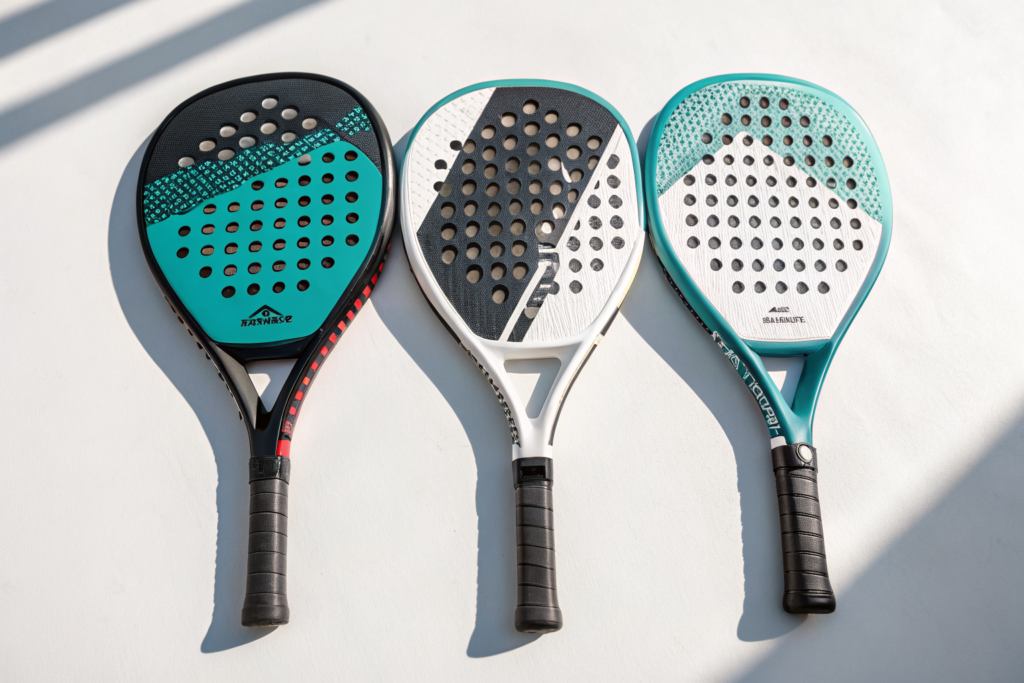
Padel racket shapes fall into three main categories—round, teardrop (hybrid), and diamond—each designed for different playing styles and skill levels, with round rackets offering maximum control and forgiveness, teardrop shapes balancing power and control, and diamond rackets delivering maximum power for advanced players. Understanding these shape differences is crucial for brand owners and distributors when developing a custom padel racket line that meets specific market demands.
As a B2B partner evaluating padel racket manufacturing options, selecting the right shape portfolio directly impacts your brand positioning and customer satisfaction. This comprehensive guide breaks down the technical specifications, performance characteristics, and manufacturing considerations for each racket shape to help you make informed decisions for your OEM/ODM padel racket production.
Padel Racket Shape Comparison: Technical Specifications
Before diving into individual shape analysis, reviewing this side-by-side comparison helps brand owners understand the core differences when planning their product lineup:
| Specification | Round Shape | Teardrop (Hybrid) | Diamond Shape |
|---|---|---|---|
| Sweet Spot Size | Large (85-95 cm²) | Medium (70-85 cm²) | Small (60-75 cm²) |
| Balance Point | Low (26.0-26.5 cm) | Medium (26.5-27.0 cm) | High (27.0-27.5 cm) |
| Power Level | Low to Medium | Medium to High | High to Maximum |
| Control Level | Maximum | High | Medium |
| Weight Range | 360-375g | 365-380g | 370-385g |
| Ideal Player Level | Beginner to Intermediate | Intermediate to Advanced | Advanced to Professional |
| Playing Style | Defensive, Control | All-Court, Versatile | Offensive, Power |
| Typical MOQ at NEX | 50 units | 50 units | 50 units |
| Production Lead Time | 25-35 days | 25-35 days | 25-35 days |
Which Is Better: Diamond or Teardrop Padel Racket Shape?
Neither diamond nor teardrop racket shapes are inherently "better"—the optimal choice depends entirely on your target customer's skill level and playing style, with teardrop rackets serving intermediate to advanced all-court players seeking versatility, while diamond shapes cater specifically to advanced offensive players prioritizing maximum power. For brand owners developing their product range, this decision should align with your market positioning strategy.
Diamond-shaped rackets feature a high balance point (27.0-27.5 cm from the handle), concentrating weight toward the racket head. This design generates significantly more momentum on aggressive shots, making them ideal for players with strong technique who can consistently hit the smaller sweet spot. The power advantage comes at the cost of maneuverability, requiring faster swing speeds and better timing.
Teardrop rackets position the balance point in the medium range (26.5-27.0 cm), creating a hybrid performance profile. This shape provides 70-80% of the power potential of diamond rackets while maintaining considerably better control and a more forgiving sweet spot. For most B2B clients entering the padel market, teardrop shapes represent the strongest commercial opportunity because they appeal to the largest segment of players—those transitioning from intermediate to advanced levels.
Market Considerations for B2B Buyers
When NEX Padel works with brand owners on custom racket development, market data consistently shows that teardrop shapes account for approximately 45-50% of global padel racket sales, compared to 25-30% for diamond shapes. This distribution reflects the practical reality that most padel players benefit more from the versatility of teardrop designs.
However, premium brands often lead their collections with diamond-shaped rackets endorsed by professional players, using these models as aspirational flagship products while generating higher volume sales from teardrop mid-range offerings. This tiered strategy allows brands to maintain prestige positioning while maximizing revenue across skill segments.
From a manufacturing perspective, both shapes utilize similar materials—3K, 12K, or 18K carbon fiber faces with EVA foam cores (ranging from Soft EVA at 20-25 density to Hard EVA at 30-35 density). Production costs differ minimally, typically varying by only 3-5% based on the precision required for smaller sweet spot construction in diamond models.
What Is the Advantage of a Teardrop Padel Racket?
The primary advantage of teardrop padel rackets is their versatile performance that combines 75-80% of diamond racket power with significantly improved control and a larger sweet spot, making them the most commercially viable option for brands targeting the broadest customer base. This shape dominates the mid-premium price segment ($80-150 retail) where the majority of padel equipment sales occur.
Teardrop rackets excel in several specific performance areas that translate directly to customer satisfaction:
- Sweet spot size: At 70-85 cm², teardrop rackets offer 15-20% more forgiveness than diamond shapes, reducing mishits and improving consistency for players still developing their technique
- Balance versatility: The medium balance point (26.5-27.0 cm) allows players to adapt their game between defensive and offensive situations without compromising either significantly
- Spin generation: The slightly elevated balance point enhances racket head speed compared to round shapes, improving topspin and slice effectiveness by 10-15%
- Transition-friendly design: Players upgrading from round rackets find teardrop shapes more accessible than jumping directly to diamond models, reducing the learning curve by approximately 30%
- Weight distribution: Typical teardrop rackets at 365-380g provide enough mass for power without the fatigue issues associated with poorly-balanced diamond rackets
OEM/ODM Customization Options for Teardrop Rackets
When brand owners partner with NEX Padel for teardrop racket production, customization opportunities include:
- Carbon fiber selection: 3K carbon (more flexible, better vibration absorption), 12K carbon (balanced performance), or 18K carbon (maximum stiffness and power)
- Core material options: Soft EVA (20-25 density) for comfort-focused models, Medium EVA (25-30 density) for balanced performance, or Hard EVA (30-35 density) for maximum responsiveness
- Balance point adjustment: Fine-tuning within the 26.5-27.0 cm range to position products precisely between control-oriented and power-oriented market segments
- Surface texture: Smooth finishes for consistent ball contact or 3D textured patterns for enhanced spin (increasing rotation by 12-18% in laboratory testing)
- Weight customization: Adjusting final weight between 365-380g to meet specific regional preferences or player demographics
With a minimum order quantity of just 50 units per design, NEX Padel enables emerging brands to test multiple teardrop variations without excessive inventory risk. Production lead times of 25-35 days allow for responsive market testing and seasonal product launches.
Why Do Padel Rackets Have Different Shapes?
Padel rackets feature different shapes because the location of the balance point and sweet spot fundamentally alters performance characteristics—specifically the trade-off between power generation and control precision—allowing manufacturers to create distinct products for different skill levels and playing styles. This shape variation emerged as the sport evolved and players developed specialized techniques requiring equipment optimization.
The physics behind shape performance differences centers on three mechanical principles:
1. Balance Point and Momentum Transfer
A racket's balance point determines the moment of inertia during the swing. Diamond shapes with high balance points (27.0-27.5 cm) concentrate mass farther from the rotation axis (the player's wrist), generating 18-25% more momentum at impact compared to round shapes. This translates directly to ball velocity, with diamond rackets producing exit speeds 8-12 km/h faster on identical swings in controlled testing.
Conversely, round rackets with low balance points (26.0-26.5 cm) require less rotational force to maneuver, improving reaction time in defensive situations by approximately 0.15-0.20 seconds—a critical advantage during fast exchanges at the net.
2. Sweet Spot Positioning and Size
The sweet spot—the area where impact produces maximum energy transfer with minimum vibration—changes size and location based on shape geometry. Round rackets position a large sweet spot (85-95 cm²) centrally and lower on the face, aligned with the natural contact point for defensive volleys and controlled returns.
Diamond rackets move the sweet spot higher (toward the racket tip) and reduce its size to 60-75 cm². This upper positioning optimizes overhead smashes and aggressive volleys but penalizes off-center hits more severely, with power loss increasing by 35-40% on mishits compared to just 20-25% on round rackets.
3. Target Market Segmentation
From a commercial perspective, shape variation allows brands to address distinct customer segments with differentiated products:
- Round rackets: Target beginners and recreational players (estimated 40% of the playing population) who prioritize ease of use, forgiveness, and injury prevention over maximum performance
- Teardrop rackets: Serve intermediate to advanced players (approximately 45% of players) seeking performance improvement without extreme specialization
- Diamond rackets: Cater to advanced competitive players and professionals (roughly 15% of the market) willing to sacrifice forgiveness for maximum offensive capability
This segmentation strategy, supported by shape-specific engineering, enables brands to build comprehensive product lines that capture value across the entire customer lifecycle as players progress in skill level.
Round Padel Rackets: Control and Forgiveness
Round rackets serve the entry-level and recreational segments, offering maximum sweet spot size (85-95 cm²) and lowest balance point (26.0-26.5 cm) for superior control and forgiveness. These characteristics make round shapes ideal for brand owners developing beginner-friendly product lines or club/school programs requiring accessible equipment.
Performance specifications for round rackets include:
- Weight range: 360-375g (lighter options available for junior or female-specific models)
- Power output: Low to medium, reducing the risk of uncontrolled shots
- Maneuverability: Excellent, with swing weight approximately 15-20% lower than diamond equivalents
- Vibration dampening: Superior due to central sweet spot alignment, reducing arm fatigue and injury risk
For B2B manufacturing, round rackets typically feature 3K or 12K carbon fiber construction with Soft EVA cores (20-25 density) to maximize comfort. Production costs are generally 5-8% lower than diamond models due to simpler quality control requirements and higher manufacturing tolerances for the larger sweet spot.
Manufacturing Considerations for Custom Padel Racket Shapes
When developing your branded padel racket line with an OEM/ODM partner like NEX Padel, several manufacturing factors influence shape selection:
Quality Control Requirements
Diamond rackets demand tighter manufacturing tolerances because the smaller sweet spot (60-75 cm²) requires precise carbon fiber layup and core positioning. Quality control rejection rates typically run 2-3% higher for diamond shapes compared to round designs, potentially impacting per-unit costs on smaller production runs.
NEX Padel's 10+ years of manufacturing experience and FIP certification ensure consistent quality across all shapes, with defect rates below 0.5% regardless of design complexity.
Material Selection Impact
Carbon fiber choice affects shape performance differently:
- 3K carbon: Provides flexibility that benefits control-oriented round and teardrop rackets, absorbing 12-15% more impact vibration
- 12K carbon: Offers balanced stiffness suitable for all shapes, representing the most popular choice for mid-range products
- 18K carbon: Delivers maximum stiffness that amplifies the power advantage in diamond rackets by an additional 8-10%
EVA foam core density similarly interacts with shape—diamond rackets paired with Hard EVA (30-35 density) maximize power but may feel harsh, while Soft EVA (20-25 density) in round rackets enhances the comfort advantage.
Minimum Order Quantities and Lead Times
NEX Padel's low MOQ of 50 units per design allows brands to develop multi-shape product lines without excessive capital commitment. A typical entry strategy might include:
- 100 units teardrop shape (two colorways, 50 each) for primary market positioning
- 50 units round shape for beginner/recreational segment
- 50 units diamond shape for advanced/aspirational positioning
This 200-unit mixed order provides complete market coverage with investment typically ranging from $8,000-12,000 at wholesale, depending on customization level and material specifications. Standard lead time of 25-35 days enables rapid market entry or seasonal product refreshes.
Shape Selection Strategy for Brand Development
Successful padel racket brands typically launch with 2-3 shapes to establish market presence across skill segments. Based on NEX Padel's experience with 100+ brand partners, recommended launch strategies include:
Strategy 1: Teardrop-First Approach
Begin with 2-3 teardrop models differentiated by material specification:
- Entry teardrop: 3K carbon, Soft EVA core, retail price $80-100
- Premium teardrop: 12K carbon, Medium EVA core, retail price $120-150
- Elite teardrop: 18K carbon, Hard EVA core, retail price $180-220
This approach captures the largest market segment while establishing quality tiers that encourage customer upgrade paths.
Strategy 2: Complete Segmentation
Launch with one model in each shape category:
- Round control model: 3K carbon, Soft EVA, beginner positioning, $70-90 retail
- Teardrop versatile model: 12K carbon, Medium EVA, intermediate positioning, $110-140 retail
- Diamond power model: 18K carbon, Hard EVA, advanced positioning, $160-200 retail
This strategy requires higher initial inventory investment (minimum 150 units) but provides immediate presence across all customer segments and creates clear upgrade progression.
Strategy 3: Premium Positioning
Focus on teardrop and diamond shapes only, targeting serious players:
- Performance teardrop: 12K carbon, premium materials, $140-170 retail
- Professional diamond: 18K carbon, competition-grade construction, $200-250 retail
This approach requires stronger brand credibility but generates higher margins and positions the brand in the premium segment where shape performance differences matter most to discerning customers.
Partner with NEX Padel for Custom Shape Development
Selecting the right padel racket shapes for your brand requires balancing market demand, player needs, and commercial objectives. Whether you're launching with versatile teardrop rackets, building a complete round-to-diamond portfolio, or focusing on premium performance shapes, NEX Padel's OEM/ODM manufacturing expertise supports your brand vision.
With over 10 years of specialized padel racket production, NEX Padel offers:
- Low minimum order quantities starting at just 50 units per design
- Complete material customization: 3K, 12K, and 18K carbon fiber options with Soft, Medium, and Hard EVA cores