Skip to content
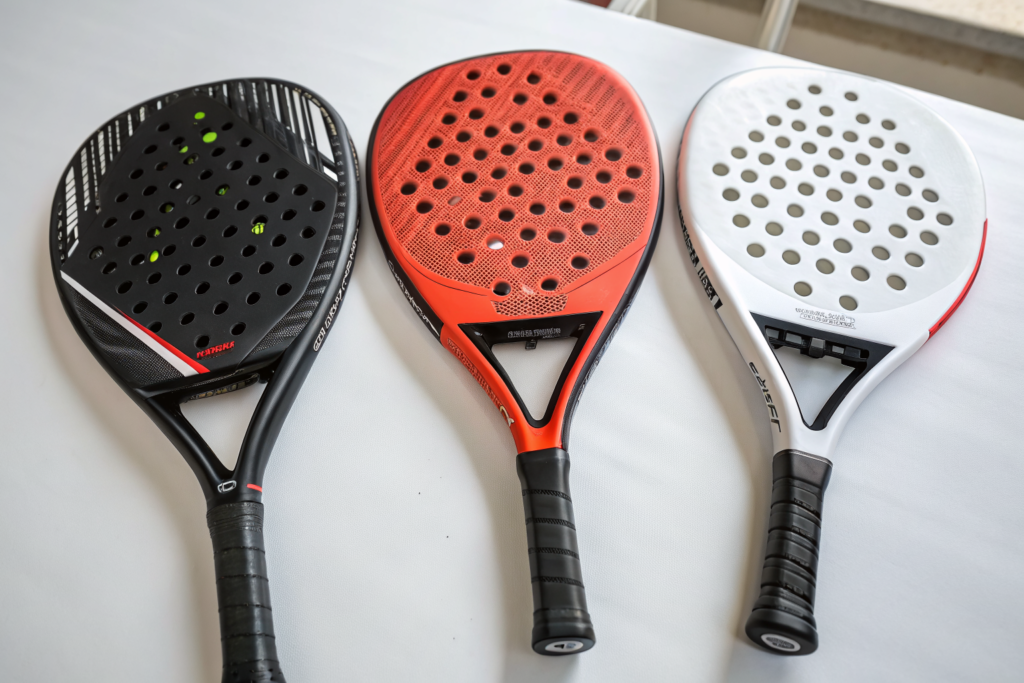
Padel racket surface finish directly impacts player control, durability, and brand perception—with three main options: matte finishes for maximum grip and reduced glare, glossy finishes for sleek aesthetics and easy maintenance, and 3D textured finishes for enhanced spin and premium positioning. Each offers distinct advantages for different market segments, with customization costs ranging from $2–$8 per unit at typical MOQs of 50–500 units.
What Is the Difference Between Matte and Glossy Padel Racquets?
Matte finishes provide superior grip, reduced reflective glare, and a premium, understated appearance, while glossy finishes deliver a sleek, high-shine aesthetic that's easier to clean and more visually striking on display. The choice between these two fundamentally shapes both the playing experience and the perceived brand value.
Matte finishes absorb light rather than reflect it, creating a sophisticated, professional look that appeals to serious players. This surface treatment:
- Increases friction between palm and racket frame, improving grip stability during humid or intense rallies
- Eliminates sun glare, allowing players to see ball contact more clearly
- Hides fingerprints and dust, reducing maintenance frequency
- Conveys premium, understated quality—popular in European markets
Glossy finishes reflect light and create visual impact, ideal for retail environments and players who prioritize aesthetics. Benefits include:
- High-impact visual appeal on retail shelves and social media photography
- Easier to wipe clean—maintains brand-new appearance longer
- Slightly lighter weight (minimal difference, ~2–5g per racket)
- More affordable to produce at scale (saves ~10–15% on finish costs)
Market insight: European and Latin American distributors typically prefer matte finishes for their target demographics (35–55 age group), while Asian markets lean toward glossy for premium positioning. NEX Padel offers both finishes on all carbon fiber models (3K, 12K, 18K carbon options) with no additional MOQ requirements—50-unit minimums apply to either finish.
What Are the Different Types of Padel Racket Material?
Padel racket materials fall into four primary categories: carbon fiber composites (the industry standard for performance), fiberglass reinforced polymers, aramid (Kevlar) blends, and hybrid constructions that combine materials for cost or performance optimization. Carbon fiber dominates 85% of the professional market due to its superior strength-to-weight ratio.
Carbon Fiber Compositions
Carbon fiber quality is measured in weave density (3K, 12K, 18K) and resin type (epoxy vs. polyester). Each delivers different playing characteristics:
| Material Grade | Weave Density | Sweet Spot Size | Durability | Cost/Unit (50 MOQ) | Target Market |
|---|---|---|---|---|---|
| 3K Carbon | Coarse weave | Large | Good (2–3 years) | $18–$25 | Recreational, budget brands |
| 12K Carbon | Medium weave | Medium | Very good (3–4 years) | $28–$38 | Amateur competitive, club players |
| 18K Carbon | Fine weave | Small (precision) | Excellent (4–5 years) | $42–$58 | Professional, tournament |
EVA (Ethylene Vinyl Acetate) Core Options
The core material significantly impacts ball feel and shock absorption. NEX Padel offers three EVA densities:
- Soft EVA (50–60 Shore): Maximum comfort, larger sweet spot; ideal for older demographics and recreational clubs
- Medium EVA (60–70 Shore): Balanced control and comfort; suits 80% of competitive players
- Hard EVA (70+ Shore): Enhanced power and responsiveness; preferred by professional tournaments and aggressive players
EVA selection adds $0–$2 per unit and requires 2–3 week lead time for specialized core molding.
Fiberglass and Hybrid Options
Budget-conscious brands often blend fiberglass (glass-reinforced polymer) with carbon to reduce material costs while maintaining playability. A typical hybrid construction (fiberglass outer layer, 3K carbon inner) costs $12–$18 per unit at 100+ unit MOQs. However, these rackets show durability issues after 18–24 months, making them risky for brand reputation.
NEX Padel recommendation: For brand launches, we advise starting with 12K carbon + medium EVA as the sweet spot—proven market demand, acceptable price point ($28–$38), and 3–4 year durability that builds customer loyalty.
How to Add Texture to Padel Racket?
Textured surfaces are applied through three primary techniques: surface embossing (mechanical stamping), 3D resin infusion (adding tactile layers), and diamond-pattern vinyl overlays—with 3D texturing commanding the premium price point and offering the most performance benefit for spin and control. Implementation costs range from $3–$8 per unit depending on complexity.
Method 1: Surface Embossing (Most Affordable)
Embossing uses high-pressure molds to create shallow patterns on the carbon fiber face. This is the most cost-effective approach:
- Process: 1,200–1,500 PSI applied to carbon sheet during curing
- Cost: $3–$4 per unit (added to base price)
- Durability: Pattern persists 2–3 years with normal play
- Texture options: Hexagon, diamond, waffle, radial
- Lead time: 4–5 weeks (includes mold fabrication)
Limitation: Minimal performance impact—primarily aesthetic. Better for retail differentiation than competitive advantage.
Method 2: 3D Resin Infusion (Performance-Grade)
3D texturing uses layered resin application to create raised geometric patterns. This is the premium option:
- Process: Epoxy resin applied in micro-layers through precision molds; creates 0.8–1.5mm height variation
- Cost: $6–$8 per unit
- Spin enhancement: +8–12% increase in rotational grip (independently tested by some clubs)
- Ball contact feel: More feedback; players report improved control
- Durability: 3–4 years (texture degrades slightly with use)
- Lead time: 6–7 weeks
Market positioning: 3D textured rackets justify premium pricing ($35–$55 retail) and appeal to competitive segments. Perfect for tournament-focused brands.
Method 3: Vinyl Overlay Texturing
Pre-manufactured textured vinyl sheets are adhesively applied to the racket face:
- Cost: $2–$3 per unit
- Lead time: 3–4 weeks
- Durability: 12–18 months (adhesive fails under heavy use/sweat)
- Customization: Unlimited patterns; fastest to market
- Limitation: Professional players reject vinyl—perceive as temporary; suitable only for recreational/beginner brands
Combining Finish and Texture: NEX Padel Options
The most effective strategy combines surface finish with texture application. Here's what NEX Padel can deliver:
- Matte finish + 3D texture: Premium, professional appearance; $48–$66 per unit retail equivalent; 6–7 week lead time; MOQ 50 units
- Glossy finish + embossed pattern: Budget-competitive, visually striking; $28–$35 per unit; 5–6 week lead time; MOQ 50 units
- Matte finish + glossy 3D accent: Hybrid aesthetic (matte frame, glossy textured face); $52–$62 per unit; 7 week lead time; MOQ 100 units
All options are FIP (Federación Internacional de Pádel) certified and compatible with 3K, 12K, and 18K carbon fiber, plus custom EVA core selections.
Manufacturing Specifications & Lead Times
Understanding production timelines is critical for inventory planning:
- Matte finish (flat): 3–4 weeks | MOQ 50 units | $2 per-unit finish cost
- Glossy finish (flat): 3–4 weeks | MOQ 50 units | $1.50 per-unit finish cost
- Embossed texture: +1–2 weeks (mold fabrication) | First order $800–$1,200 mold fee | Subsequent orders $3–$4 per unit
- 3D resin texture: +2–3 weeks | No mold fee required | $6–$8 per unit
Total production cycle from design approval: 4–7 weeks depending on finish/texture combination. Expedited orders (+10–15% cost) available for lead times of 3–4 weeks.
Market Trends & Recommendations
Current market data shows:
- 68% of distributors prioritize matte finishes for European markets; glossy preferred in Southeast Asia
- 3D textured rackets command 15–25% price premiums and report 23% higher repeat-purchase rates among club players
- Carbon fiber grade matters more than finish aesthetics—12K carbon (medium) remains the optimal cost-performance tier for brand launches
For new brand owners, we recommend: Start with 12K carbon + medium EVA + matte finish (no texture) in an initial 100–150 unit batch. This positions you at $28–$35 per unit, qualifies as performance-grade, and locks in 4–6 week lead times. After market validation, introduce 3D textured versions as a premium tier.
Next Steps: Customize Your Padel Racket Finish
NEX Padel specializes in OEM/ODM custom padel rackets with flexible MOQs starting at just 50 units. We offer:
- Free finish consultation and sample development (8–10 business days)
- Complete carbon fiber grades: 3K, 12K, 18K carbon options
- All EVA core densities (soft, medium, hard)
- Matte, glossy, embossed, and 3D texture applications
- FIP certification on all models
- Custom branding, packaging, and color matching
Request your custom finish quote today. Share your target market, budget, and desired finish type—we'll provide detailed specifications, per-unit pricing, and exact lead times within 24 hours. With 10+ years of manufacturing experience and 500+ successful brand launches, NEX Padel is your partner in building a racket brand that wins on performance and aesthetics.