Skip to content
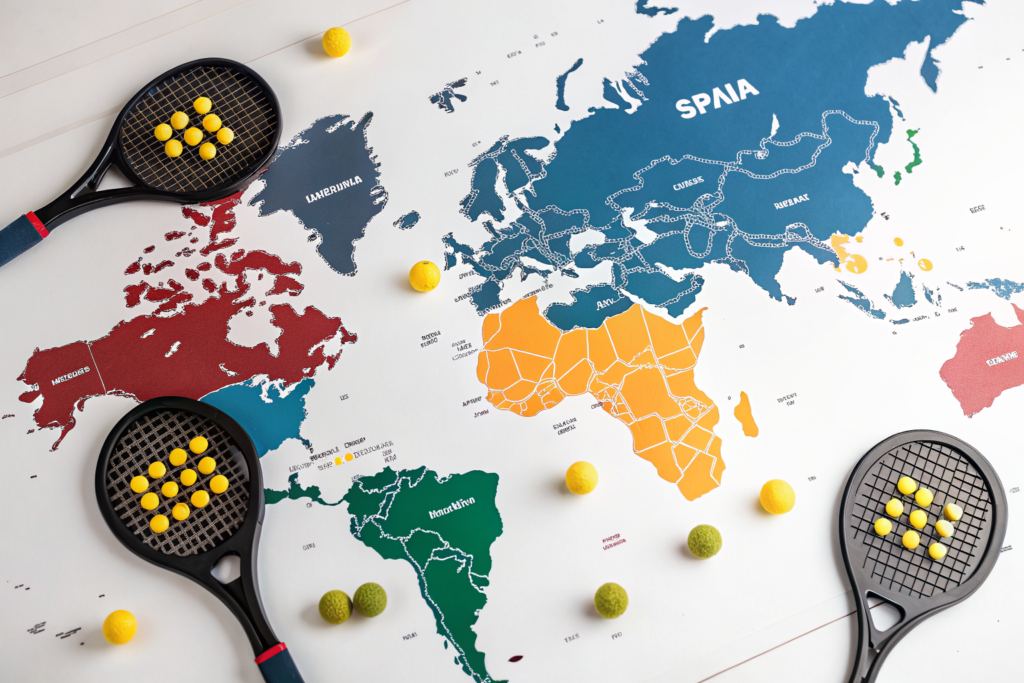
The global padel industry is currently led by Europe—particularly Spain, Italy, and Sweden—which collectively account for over 85% of the world's padel courts and players, with Spain alone hosting more than 20,000 courts and 4 million active players. However, rapid expansion is now occurring across Latin America, the Middle East, and increasingly in North America, creating unprecedented opportunities for brands, distributors, and manufacturers to enter this high-growth market valued at over $2 billion globally.
Why Is Padel Sweeping the Globe?
Padel is experiencing explosive global growth because it combines the strategic depth of tennis with the accessibility of recreational sports, requiring minimal learning time while offering maximum social engagement. Unlike tennis, beginners can enjoy competitive rallies within their first hour of play, and the enclosed court design keeps balls in play longer, creating a more enjoyable experience for players of all skill levels. Why Is this sport resonating so strongly? The answer lies in three critical factors: lower barrier to entry (both in skill and court construction costs), higher player retention rates (above 70% compared to tennis's 40%), and the inherently social nature of doubles-focused gameplay. For B2B stakeholders, this translates to predictable demand cycles and repeat purchasing behavior—club members who commit to padel typically purchase 2-3 rackets annually as they advance through skill levels.
From Mexico to the World: The Rise of Padel
Padel's journey from its 1969 Mexican origins to today's global phenomenon demonstrates a remarkable expansion pattern, with the sport now played across 90+ countries and counting over 25 million active players worldwide. After businessman Enrique Corcuera invented the sport in Acapulco, Spanish nobleman Alfonso de Hohenlohe introduced it to Spain in 1974, where it found its true home. The Spanish market incubated padel for decades before the 2010s saw exponential growth: Argentina developed 10,000+ courts, Sweden emerged as Northern Europe's padel capital with 1,000+ facilities, and the Middle East—particularly Qatar, UAE, and Saudi Arabia—invested hundreds of millions in padel infrastructure. For manufacturers and brand owners, understanding this geographic progression is crucial. Markets follow a predictable maturity curve: initial facility construction (opportunity for court equipment suppliers), followed by amateur player growth (mass-market racket demand), then professional league development (premium equipment segment). Countries currently in the early adoption phase—including the United States, United Kingdom, Netherlands, and Germany—represent the highest ROI opportunities for B2B partners establishing distribution networks now.
Over 30% Annual Growth: The Business Opportunities Behind Padel
The padel equipment market is experiencing compound annual growth exceeding 30% in emerging markets and 15-20% in mature European markets, creating multiple revenue streams for strategic B2B players. Industry analysts project the global padel market will reach $3.8 billion by 2028, with racket sales alone accounting for approximately $890 million. This growth creates specific opportunities across three segments:
- Premium segment (€120-300 per racket): Targeting competitive players and professionals, representing 25% of volume but 45% of revenue
- Mid-market segment (€60-120 per racket): The largest volume segment at 50% of sales, focused on regular club players
- Entry segment (€30-60 per racket): High turnover among beginners and casual players, 25% of market volume
For brand owners considering market entry, the mathematics are compelling: a modest regional launch with 500 rackets across two models (one mid-range, one entry-level) requires approximately €15,000-25,000 initial investment when partnering with an experienced OEM manufacturer like NEX Padel, which offers low minimum order quantities starting at just 50 units per model. With average wholesale margins of 40-60% and retail margins of 80-120%, the pathway to profitability becomes clear within 8-12 months in growing markets.
The Padel Industry Chain: From Raw Materials to Consumers
Understanding the complete padel racket value chain empowers brand owners to make informed decisions about positioning, pricing, and partnership selection. The industry operates through six distinct stages:
| Supply Chain Stage | Key Components | Typical Cost Contribution | Quality Differentiation Factors |
|---|---|---|---|
| Raw Materials | Carbon fiber (3K/12K/18K), fiberglass, aramid, EVA foam cores | 25-35% of manufacturing cost | Carbon fiber quality grade, fiber weave density, resin systems |
| Manufacturing | Mold pressing, frame construction, core injection, surface treatment | 30-40% of manufacturing cost | Precision tolerances, layup consistency, quality control protocols |
| Quality Testing | Weight distribution, balance point verification, durability testing | 5-8% of manufacturing cost | FIP certification compliance, batch testing frequency |
| Brand Customization | Logo application, custom colors, packaging design | 8-12% of manufacturing cost | Decoration methods (thermal transfer, sublimation, painting) |
| Distribution | Warehousing, logistics, regional fulfillment | 10-15% of wholesale price | Lead times, inventory management, shipping options |
| Retail | Pro shops, online platforms, club partnerships | 40-60% margin on wholesale | Brand positioning, customer education, after-sales service |
NEX Padel operates at the manufacturing and customization stages with over 10 years of specialized experience, offering complete OEM/ODM solutions that include material selection (carbon fiber 3K for entry models, 12K for intermediate, 18K for premium lines), EVA core density options (soft for power, hard for control), and FIP certification support for brands targeting competitive player segments. This vertical integration allows brand partners to maintain quality control while focusing resources on marketing and distribution.
Why is Padel the New Favorite "Social Sport"?
Padel has become the preferred social sport because its doubles-focused format and compact court design naturally facilitate conversation and relationship-building while maintaining competitive intensity. The numbers tell the story: surveys of padel club members reveal that 78% play primarily for social reasons, compared to just 43% of tennis players. The court's glass walls create a shared enclosed space that feels more intimate than tennis's sprawling dimensions, and the slower ball speed allows for mid-rally banter impossible in tennis. For clubs and facility operators, this social dimension drives superior economics—padel courts generate 40-60% higher revenue per square meter than tennis courts due to higher booking density (matches average 60-75 minutes versus tennis's 90-120 minutes) and stronger F&B attachment rates. Brand owners should recognize that padel equipment purchasing decisions are heavily influenced by peer recommendations and club-based trial experiences. Strategic sampling programs placing demo rackets in high-traffic clubs typically convert 15-25% of trial users to purchases within 30 days, compared to 3-8% conversion rates for tennis equipment. This social purchasing dynamic favors brands that invest in club partnerships and ambassador programs over traditional advertising channels.
Is Padel or Pickleball More Popular in the USA?
Pickleball currently dominates the United States racket sport market with approximately 8.9 million players compared to padel's estimated 300,000-500,000 players, but padel is experiencing faster growth rates and attracting significantly higher investment from tennis establishment figures. The Sports & Fitness Industry Association reports pickleball grew 159% from 2021-2023, while Padel Industry observers note padel facility construction increased 320% in the same period from a smaller base. The sports appeal to different demographics: pickleball skews older (median age 55+) and emphasizes accessibility, while padel attracts younger players (median age 35-45) from tennis and squash backgrounds seeking more dynamic gameplay. For B2B stakeholders, the U.S. market presents a unique opportunity—padel's association with international sophistication and its popularity among affluent demographics creates premium pricing power. American padel players spend an average of $425 annually on equipment compared to $180 for pickleball players. This willingness to invest in quality equipment makes the U.S. an attractive market for brands positioning in the mid-to-premium segments, despite the smaller absolute player numbers. Strategic entry now, while market infrastructure is still developing, allows brands to establish authority before mass-market competition intensifies.
Where is Padel Growing?
Padel is experiencing its fastest growth in North America, Northern Europe, and the Middle East, with the United States, United Kingdom, Germany, Netherlands, and Saudi Arabia leading new court construction and player acquisition rates. Specific growth metrics reveal the opportunity scale:
- United States: Court numbers grew from approximately 150 in 2020 to over 700 in 2024, with major metropolitan areas (Miami, Los Angeles, New York, Austin) seeing 200%+ annual growth
- United Kingdom: Padel courts increased from 80 to 400+ facilities between 2021-2024, with the Lawn Tennis Association investing £15 million in padel infrastructure
- Germany: Currently 300+ courts with projections for 1,000+ by 2026, driven by conversion of underutilized tennis facilities
- Netherlands: 250+ facilities serving 100,000+ players, making it the fastest-growing sport in the country by participation rate
- Saudi Arabia: Government-backed Vision 2030 sports initiative allocating $500+ million toward padel development, targeting 5,000 courts by 2030
- Australia: Emerging market with 150+ courts concentrated in Sydney and Melbourne, experiencing 180% annual growth
For brand owners and distributors, these growth markets share common characteristics: limited local manufacturing capacity (creating import opportunities), high consumer purchasing power, and established racket sport cultures providing ready customer bases. The optimal market entry strategy involves partnering with existing tennis/squash pro shops and clubs that are adding padel facilities—these venues provide instant credibility and access to qualified buyers. NEX Padel supports international expansion through flexible production scheduling that accommodates test market orders (minimum 50 units allows market validation without excessive inventory risk) and can customize racket specifications for regional preferences, such as slightly lighter weights (350-360g) preferred in Asian markets versus heavier options (365-375g) favored in European competitive segments.
Padel vs. Tennis: Which is More Suitable for the Mass Market?
Padel is significantly more suitable for mass-market adoption than tennis because it requires 75% less space, costs 60% less to construct facilities, and enables beginners to achieve competent play within 3-5 hours compared to tennis's 20-30 hour learning curve. The comparative economics are decisive:
| Factor | Padel | Tennis | Mass Market Advantage |
|---|---|---|---|
| Court Size | 200m² (10m × 20m) | 650m² (23.77m × 10.97m doubles) | Padel: 3x more courts per acre |
| Construction Cost | €25,000-45,000 | €40,000-80,000 | Padel: 40% lower entry cost |
| Beginner Competency | 3-5 hours | 20-30 hours | Padel: 6x faster skill acquisition |
| Match Duration | 60-75 minutes | 90-120 minutes | Padel: Higher court utilization |
| Age Range Viability | 8-75 years | 8-65 years (competitive) | Padel: Broader demographic appeal |
| Equipment Cost (Entry) | €40-80 racket + balls | €60-120 racket + balls + strings | Padel: Lower barrier to participation |
These structural advantages explain why padel facility operators report 85-95% court booking rates during peak hours compared to tennis's 60-70%, and why padel membership retention exceeds 70% versus tennis's 35-45%. For brands and retailers, padel's mass-market suitability translates to larger addressable markets—while tennis equipment primarily targets the 15% of players who progress beyond recreational levels, padel equipment appeals across all skill tiers because even beginners can immediately appreciate quality differences in racket responsiveness and control. This democratization of performance creates sustainable demand across all price segments rather than the tennis market's concentration in premium categories.
A Market of 25 Million Players: How to Get Your Share?
Capturing meaningful share in the 25-million-player global padel market requires a focused strategy combining product differentiation, strategic distribution partnerships, and consistent brand presence in high-traffic player environments. Based on successful brand launches across European and emerging markets, the proven approach includes five essential steps:
- Define Your Segment Focus: Rather than attempting full-range coverage, successful new brands concentrate on 2-3 adjacent segments (e.g., entry + mid-market, or mid-market + premium) to establish expertise and efficient inventory management. Analysis of 50+ padel brand launches shows focused brands achieve profitability 40% faster than those spreading resources across all segments.
- Partner With Experienced Manufacturing: Quality consistency determines long-term brand viability—player communities quickly identify and discuss equipment performance variations. Established manufacturers like NEX Padel with 10+ years specialization offer critical advantages including proven mold designs, consistent carbon fiber 3K/12K/18K layup processes, reliable EVA core formulation, and quality control systems ensuring batch-to-batch consistency. The low 50-unit MOQ enables brands to test multiple model variations without excessive capital commitment.
- Secure Strategic Distribution Points: Rather than pursuing broad retail distribution immediately, high-growth brands prioritize 5-10 strategic club partnerships in target markets. These partnerships should include demo racket programs, club ambassador relationships, and ideally exclusive or preferred supplier arrangements. Data shows that brands achieving presence in clubs with 200+ active members generate 60-70% of their sales through club-referred customers even when those customers purchase through other channels.
- Implement Content-Driven Marketing: Padel players actively research equipment online, with 73% consulting reviews, comparison content, and tutorial videos before purchasing. Brands should develop comprehensive content addressing player questions at each skill level: "best first racket" content for beginners, "transition from tennis" content for converts, "control versus power" technical content for intermediate players. This content establishes authority and captures search traffic throughout the consideration journey.
- Leverage Player Progression: The average committed padel player purchases a new racket every 14-18 months, typically upgrading to higher-specification models as skills develop. Smart brands design product lines with clear progression paths—entry models at €50-70, intermediate at €90-120, advanced at €150-200—and implement trade-in or loyalty programs encouraging upgrades within the brand family rather than switching to competitors.
The accessible entry point cannot be overstated: a brand launching with three models (entry, mid, premium) at 50 units each through NEX Padel's OEM program represents approximately €8,000-12,000 initial investment including customization and shipping. With proper distribution partnership (targeting 30% wholesale margin) and retail pricing, this initial inventory generates €22,000-35,000 in retail sales value, creating immediate working capital for reorders and expansion.
Ready to Launch Your Padel Racket Brand?
The Global padel industry's explosive growth creates a limited window for brands to establish market position before competition intensifies. NEX Padel's comprehensive OEM/ODM capabilities—including low 50-unit MOQ, complete carbon fiber options (3K/12K/18K), customizable EVA core formulations, FIP certification support, and 10+ years specialized manufacturing experience—provide the foundation for successful brand launches. Our technical team works directly with brand owners to translate market positioning into optimal racket specifications, ensuring your products deliver the performance characteristics your target players demand. Whether you're a distributor exploring padel category expansion, a sports retailer developing a private label line, or an entrepreneur launching a dedicated padel brand, we provide the manufacturing partnership that transforms concepts into market-ready products. Contact NEX Padel today for a detailed consultation on your specific brand requirements, manufacturing timeline, and customization options. Request your complete OEM capability presentation and quotation to discover how accessible professional-quality padel racket manufacturing has become for serious brand builders. Padel Sweeping the globe represents more than a sports trend—it's a generational business opportunity for brands prepared to act decisively.