Skip to content

A concise answer: For padel rackets, choose a balanced combination of a micro-textured surface (mid-level roughness) with a durable matte or hybrid coating for most mid-level and club players, and a finer laser-etched1 or micro-embossed pattern on raw carbon for high-performance pro models where maximum spin is required. Specify measurable metrics (target Ra/Rz2 ranges, friction coefficient, and Taber-abrasion3 limits) and require supplier test reports showing spin delta, wear cycles, and coating adhesion to ensure repeatable, manufacturable results.
Choosing the right surface texture for padel rackets is a manufacturing and product-strategy decision, not just a marketing line. Below I compare the common surface solutions — micro-roughness (micro-abrasion), laser etching, embossing, sandblasting and coatings — by measurable performance, manufacturing practicality, durability, and regulatory risk. Use the spec recommendations and QC checkpoints to decide which technology to specify for each racket line (beginner / intermediate / pro) and how to qualify suppliers.
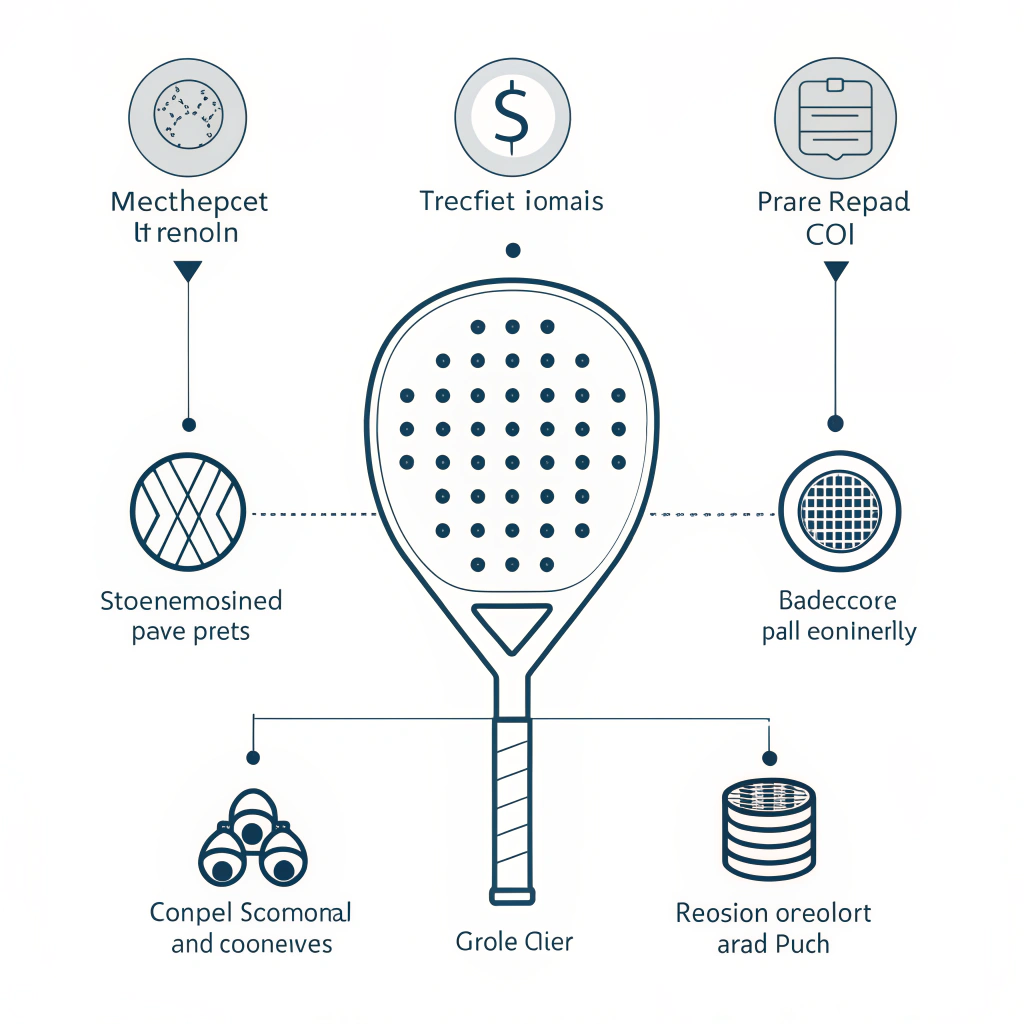
Why surface texture matters (brief)
- The surface determines the ball-contact friction and the contact time micro-dynamics that generate spin and affect control.
- Texture interacts with substrate material (carbon fiber vs fiberglass) and coating chemistry. A given texture on raw carbon will behave differently than on fiberglass with a thick polyurethane coat.
- For OEMs, repeatability, cost per unit, and regulatory acceptance (no illegal adhesives/boosters) are as important as peak spin performance.
Core differences at a glance
- Micro-roughness / micro-abrasion: textured grit or sanded surface; provides generalized spin via increased friction; good durability if sealed by a robust coating.
- Laser etching: precise, repeatable micro-patterns (grooves, dimples, directional textures); high spin potential with controlled wear; higher CAPEX and unit cost.
- Embossing: raised macro-patterns created during lamination or by mechanical pressing; visual appeal and tactile spin improvement, but more sensitivity to wear on raised edges.
- Sandblasting: random rough texture; lower control of pattern geometry, cost-effective, but needs sealing to avoid rapid wear.
- Coatings (PU, matte, hybrid): change both friction and durability; matte PU often increases grip but can wear quickly unless formulated for abrasion resistance.
Technical metrics you should specify
- Roughness: Ra (arithmetical mean roughness) and Rz (ten-point) — request supplier measurement using a profilometer4. Suggested target ranges (starting points; validate with prototypes):
- Beginner models: Ra 0.2–0.6 µm (smoother; consistent, low spin)
- Intermediate models: Ra 0.6–1.8 µm (balance spin/control)
- Pro spin-focused models: Ra 1.8–4.5 µm (higher spin potential)
Note: These ranges depend on whether the substrate is raw carbon (more effective at lower Ra) or coated fiberglass.
- Friction coefficient (µ): measure static and dynamic across ball materials used in padel (wool %). Request µ increases relative to a smooth control (e.g., +10–40% for intermediate/pro).
- Surface hardness: Shore D5 for coatings; harder coatings reduce gouging but can reduce “bite.” Typical Shore D targets: 60–75 for balanced durability; lower for tacky coatings.
- Abrasion resistance: Taber abrasion cycles (specify wheel and load). Example acceptance: < 10% change in friction after 1000 cycles for pro models.
- Adhesion: cross-cut and pull-off tests for coatings applied over textured substrates.
- Dimensional tolerances: ensure texturing process does not alter profile thickness more than ±0.1 mm per side for consistent balance/weight.
Manufacturing options, pros & cons (detailed)
| Process | Spin potential | Reproducibility | Unit cost impact | Wear behavior | Best for |
|---|---|---|---|---|---|
| Laser etching | High (patterned grooves) | Excellent (digital control) | High | Good if shallow; may expose fiber if too deep | Pro & premium lines |
| Micro-abrasion (controlled sanding) | Medium | Medium (process control needed) | Low-Medium | Good when sealed | Intermediate lines |
| Sandblasting | Medium-Low | Low | Low | Rapid wear unless coated | Entry-level or matte aesthetics |
| Embossing (during lamination) | Medium | High (molded patterns) | Medium | Durable if mold maintained | Mid to high-volume decorative lines |
| Coatings (PU/matte/hybrid) | Variable (depends on texture & tack) | High | Medium | Can be optimized for abrasion | All levels; final protective layer |
Recommended production tolerances and process controls
- Laser etch depth control: ±5 microns to avoid exposing fibers and compromising strength.
- Roughness reproducibility: ±10–15% in Ra across a batch.
- Weight variation due to texture/coating: keep within ±5 grams for performance models.
- Colour/print over textured surfaces: validate ink adhesion and opacity — textured surfaces often require special UV-curable inks or pad printing with primer.
Testing and QC protocol you must require from suppliers
- Prototype spin testing: measure ball spin rate using spin machine (rad/s) or high-speed camera, reporting delta vs. smooth control for forehand/backhand slices and serves. Provide repeat runs (n≥10).
- Friction coefficient tests: ASTM-style tribometer tests with padel ball material. Provide static and dynamic µ.
- Abrasion cycles: Taber-abrasion3 test (specify wheel type and load) with friction measured before and after.
- Adhesion & environmental aging: cross-cut adhesion and 72-hour salt-spray or UV exposure if claiming outdoor durability.
- Visual and dimensional checks: profilometer scans (Ra, Rz) across 5–10 points per surface; report mean and standard deviation.
- Failure mode analysis for wear: samples after 500/1000 cycles, microscopy photos and report on exposed fibers, coating flaking, or pattern smoothing.
Cost and production considerations
- Laser etching increases unit cost (CAPEX amortized) but reduces per-unit variability and supports high-mix runs with digital pattern changes.
- Embossing via molds is cost-effective at scale but expensive for tooling changes — good for mid-volume SKU sets.
- Sandblasting and micro-abrasion are low-CAPEX but need consistent jigs and fixture-based process controls to keep batch variability acceptable for OEM brands.
- Coatings can add 0.5–2.0 USD per unit depending on formulation and curing method; factor in curing station throughput for lead time.
Regulatory and tournament acceptance
- Avoid textures that mimic “coatings that alter ball pressure” or add external sticky substances (these can be flagged by tournament bodies). Require supplier certification that no adhesives or foreign tackifiers beyond approved coating classes are used.
- Keep test records: many federations will test surface abrasiveness and tack. Present your friction and abrasion data if applying for product acceptance.
Use-case recommendations (actionable)
- Beginner / Entry-level: Smooth to low-texture surface (Ra 0.2–0.6 µm), sealed with robust PU coat. Goal: consistency, lower maintenance.
- Intermediate / Club: Medium micro-texture (Ra 0.6–1.8 µm) via controlled micro-abrasion or embossed pattern + hybrid matte coating. Goal: balanced spin & control with reasonable wear.
- Advanced / Pro / Spin models: Laser-etched patterns on raw carbon or lightly coated carbon with Ra targets above 1.8 µm, validated spin delta +20–40% vs smooth. Require stricter abrasion acceptance and depth control to avoid exposing fibres, and short-run production to maintain pattern integrity.
- Signature / Aesthetic lines: Embossing + custom printing; validate printing adhesion on textured substrates and provide sample wear photos.
Supplier checklist before pilot production
- Can you deliver profilometer scans (Ra & Rz) and friction test reports per batch?
- Do you have laser-etch process control and depth monitoring? If using sanding, do you use jigs for consistent pressure?
- Provide Taber abrasion and adhesion test certificates.
- What is your expected yield (percentage of units within surface tolerances) for a 1k+ batch?
- Show references: brands or lines you’ve produced (NEX Padel’s own OEM relationships are an example of high-volume repeatable production).
- Lead time and changeover cost for new patterns or colors.
Case example (summary)
NEX Padel trialed three surface strategies for an intermediate line: sandblasted + matte PU; embossed textured laminate; and light laser etch on 3k carbon. Results:
- Sandblasted: low cost, good early spin, wear accelerated after 600 cycles.
- Embossed: consistent batch reproducibility, medium spin increase, excellent durability.
- Laser etch: highest spin delta (avg +32% vs smooth), best repeatability, higher unit cost.
Decision: use embossed for core mid-range SKU (cost/durability balance), reserve laser-etch for premium “spin” pro models.
Next steps — how to specify in an RFQ
- Include target Ra and allowable variability, friction delta target vs control, Taber cycles acceptance, adhesion test requirements, and sample batch size.
- Ask for a small pilot run (50–200 units) with full test report including high-speed spin measurements and wear images.
- Specify artwork and print tests if visual customization is required.
Summary (decision checklist)
- Decide your product positioning (beginner/intermediate/pro) first — match texture magnitude to user level.
- Specify measurable targets: Ra/Rz, friction coefficient, Taber-abrasion acceptance, coating Shore D5, and manufacturing tolerances.
- Choose process by volume and flexibility: embossing for mid-volume, laser etch for premium, micro-abrasion/sandblasting for low-cost lines.
- Require supplier test reports and pilot runs before committing to tooling or large orders.
People Also Ask
Q: What is the best surface for pickleball spin?
A: The best surface for spin is one that increases friction at ball contact without premature wear. Materials with raw carbon or textured composite faces and controlled micro-patterns (laser etch, embossing, or micro-roughness) provide the best spin for advanced play. Graphite/raw carbon surfaces typically offer more “bite” and control than smooth composite finishes.
Q: Does the quality of the racket affect your game?
A: Yes. Racket quality — including surface texture, material stiffness, balance, and weight consistency — affects shot control, comfort, and progression. A poorly chosen racket can reduce performance and cause discomfort; a well-specified racket improves shot precision and player confidence. For manufacturers, consistent surface specs and QC are key to delivering that performance.
Q: Are smooth or rough paddles better for pickleball?
A: Rough/textured paddles offer higher spin potential and are preferred by advanced players who use spins strategically. Smooth paddles are more forgiving and consistent for beginners. For padel OEM decisions, aim for smooth-to-medium textures for entry and club models and medium-to-high textures for performance models, following measurable roughness and durability specifications.
-
laser-etched: Read this to understand laser-etch processes (types of lasers, depth control, CAPEX vs per-unit cost), best practices to avoid fiber exposure, and how pattern geometry affects spin and wear. ↩
-
Ra/Rz: Read this to understand what Ra (arithmetical mean) and Rz (ten-point) quantify, how profilometer settings and sampling affect readings, and how to convert those metrics into actionable spec limits and acceptance criteria for different product tiers. ↩
-
Taber-abrasion: Read this to learn how Taber tests (wheel type, load, cycles) simulate wear, how to interpret cycle-based acceptance thresholds, and how to correlate Taber results with field wear and friction retention. ↩ ↩2
-
profilometer: Read this to learn how profilometers measure surface roughness (contact vs non-contact), recommended scan parameters, how to sample multiple points for statistical control, and how to report Ra/Rz with uncertainty. ↩
-
Shore D: Read this to learn what the Shore D hardness scale measures for polymer coatings, how hardness relates to abrasion resistance vs tack, and how to specify test methods and target ranges for coating formulations. ↩ ↩2