Skip to content
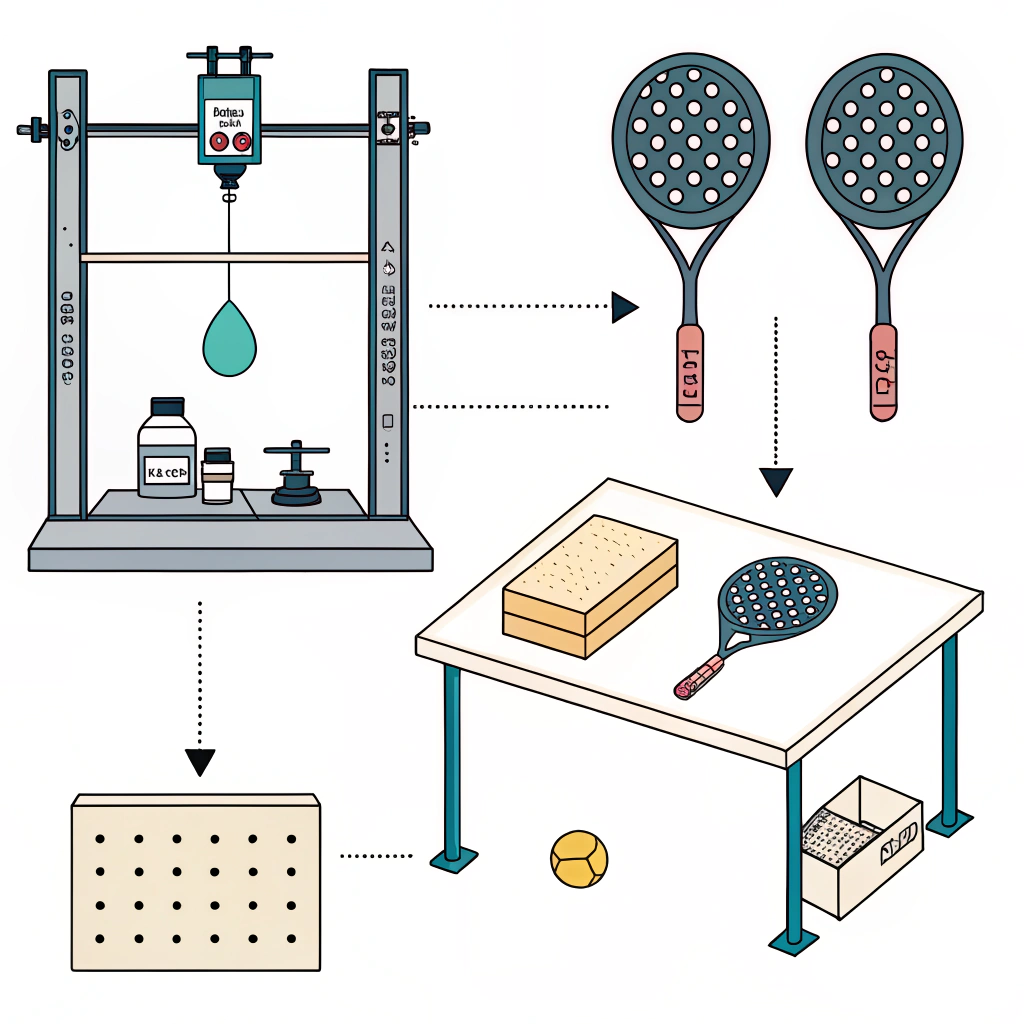
A high‑quality padel racket is defined by tight weight/balance tolerances, stable EVA hardness, consistent carbon layup, and proven fatigue life. At NEX Padel, we control this through a structured QA system from raw material to final inspection: incoming fiber and EVA testing, in‑process checks on weight and balance, lab tests (hardness, impact, fatigue, COR, adhesion), and outgoing AQL sampling (ANSI/ASQ Z1.4)1. For 3K/12K/18K carbon rackets, we typically hold ±3 g total weight, ±3 mm balance point, and Shore A EVA hardness within ±2–3 points, backed by batch traceability and ISO‑style procedures, so brands can scale private label lines with predictable performance and low warranty rates.
For a player, quality is feel, control, and durability.
For a product or sourcing manager, quality must be measurable:
- Weight window and swingweight2 range per SKU
- Balance point tolerance (e.g., 260–270 mm for a given model)
- EVA core hardness (Shore A) stability between batches
- Carbon fiber type (3K/12K/18K), orientation, and gsm repeatability
- Adhesion between core, laminates, frame, and surface
- Resistance to cracking, delamination, and surface wear
- Controlled PPM, clear AQL plan, and traceability down to batch/lot
The question is not just “Is this racket good?” but “Can this OEM reproduce the same racket 20,000 times with the same properties?”
We follow an ISO 9001–style quality loop (documented procedures, checks, and traceability), even if not every customer requires audited certification.
High level structure:
- Incoming material control
- Process control (layup, molding, curing, finishing)
- In‑house lab tests on samples and pilot runs
- Final inspection & AQL sampling before packing
- Traceability and documentation for every batch and PO

We treat incoming materials as the first critical control point.
EVA cores
- Check density and hardness (Shore A) vs. spec
- Thickness and flatness of core sheets
- Visual inspection for voids or contamination
Typical EVA core hardness ranges we work with:
| Racket feel | Shore A range | Main use case |
|---|---|---|
| Soft | 50–55 | Comfort, control‑oriented rackets |
| Medium | 55–60 | All‑round play |
| Hard | 60–65 | Power‑focused, advanced players |
We log supplier batch, test results, and link them to each production lot for traceability.
Carbon fiber (3K/12K/18K) and fiberglass
Key checks:
- GSM (g/m²)3 of fabric or prepreg
- Fiber type (3K, 12K, 18K) and weave pattern verification
- Certificate review for resin content and curing recommendations
- Visual inspection for fraying, contamination, and roll damage
We store carbon and resin under controlled conditions to protect performance—especially relevant for fatigue life and stiffness consistency.
Paints, inks, and adhesives
- Supplier declarations and test reports for REACH/RoHS compliance
- Viscosity and color checks on paints/inks
- Adhesive shelf‑life and storage temperature monitoring
The layup and molding stage is where a specification becomes a physical performance profile.
For each model (Diamond, Round, Teardrop, or custom), we maintain a layup sheet:
- Fiber type: 3K/12K/18K carbon or fiberglass
- Orientation: 0°/90°, ±45°, or hybrid sequences
- Ply count and exact ply positions (face, frame, core interface)
- Resin system and curing profile (temperature vs. time)
This is controlled with:
- Printed layup maps at each station
- Pre‑cut kits with barcodes (to avoid ply confusion)
- Random audits: weight and thickness of pre‑laminated stacks
We monitor:
- Press temperature and pressure vs. curing curve
- Time in mold (over‑ or under‑curing affects stiffness and durability)
- Mold clamping alignment (critical for consistent thickness and frame shape)
Each press cycle is logged (ID, date, operator, parameters), so any later issue can be traced back to specific cycles.
Many brands ask, “Which tests actually predict on‑court performance and durability?” These are the core ones we use and recommend.

Static weight
- Measured on calibrated electronic scales
- Typical spec: e.g., 360–370 g finished weight per model
- Our internal target: ±3 g tolerance for mid‑ to high‑end lines, ±5 g for entry‑level
Balance point
- Measured from the butt cap to the point of equilibrium
- Key to categorizing head‑light, even, head‑heavy rackets
- Typical tolerance: ±3 mm around target; we can tighten on request
Swingweight (moment of inertia)
We use a swingweight machine (pendulum or rotational type):
- Measures resistance to rotation, which players feel as maneuverability
- Crucial for matching rackets in high‑end lines
- Used to separate models with same static weight but different “feel”
Example of our internal target ranges (illustrative):
| Model type | Target static weight | Balance point | Swingweight range (kg·cm²) |
|---|---|---|---|
| Round | 355–365 g | 260–270 mm | 115–125 |
| Teardrop | 360–370 g | 265–275 mm | 120–130 |
| Diamond | 365–375 g | 270–280 mm | 125–135 |
We use a Shore A durometer on prepared EVA samples and on the core before assembly where accessible.
Why it matters:
- Controls power vs. control: harder core → more rebound and direct feel; softer core → more dwell time, comfort
- Affects vibration behavior and arm comfort
We track:
- Supplier batch average and standard deviation
- Core hardness after molding (to see if curing or heat affected it)
Typical tolerance: ±2–3 Shore A points around the nominal spec, depending on customer requirements.
4.3 Torsional rigidity4 and flex
We run bending/torsion tests:
- Mount racket, apply a defined load at the head
- Measure deflection (flex) and twist angle (torsional rigidity)
Use cases:
- Ensures 3K vs. 12K vs. 18K models have distinct stiffness profiles
- Prevents “soft” batches when fiber orientation or curing drifts
We store curves and numerical stiffness values per batch so brands can compare over time.
Single impact tests
- Drop‑weight or instrumented impact at predefined spots (center, upper head, frame)
- Check for cracks, delamination, permanent deformation
Fatigue tests
- Repeated impact simulation (e.g., thousands of cycles at controlled energy)
- Measure stiffness change and inspect for micro‑cracks or bonding failures
These tests correlate with:
- Real‑world fracture rate and warranty claims
- Performance degradation after months of play
For brands, we can agree on:
- Maximum allowed stiffness loss after X cycles
- No visible delamination or cracks after fatigue test
4.5 Coefficient of restitution (COR)5 / rebound
To approximate “liveliness”:
- Fire a standardized ball at defined speed onto a fixed racket setup
- Measure rebound speed and compute COR (ratio of rebound velocity to incoming velocity)
Uses:
- Compare different EVA hardness levels
- Validate power claims between model lines
- Keep production within a defined “feel window”
Delamination can destroy brand reputation. We conduct peel tests:
- Measure the force to separate layers (carbon–EVA, surface–laminate, bumper–frame)
- Detect issues in resin mix, surface prep, or curing
We set minimum peel strength values with customers for premium lines.
For rough or sanded faces:
- Abrasion tests using standardized media and cycles
- Measure roughness loss vs. initial value
- Visual grading for patchy wear or flaking
This helps predict:
- Lifespan of spin‑enhancing textures
- Risk of customer complaints about “smooth” rackets after short use

Each batch goes through:
- Frame geometry check (warping, symmetry)
- Face flatness and edge finishing
- Paint/print quality (color, registration, logo clarity)
- Grip and butt cap alignment/logo correctness
We use go/no‑go gauges for critical dimensions where needed.
Every racket:
- Weighed and balance point measured
- Compared to model specification and tolerance
Out‑of‑spec units are tagged, quarantined, and investigated, with root cause recorded and corrective action taken.
For outgoing quality control, we apply AQL sampling plans (or follow your own if provided).
Typical setup (example):
| Inspection level | Lot size | AQL (major) | AQL (minor) | Focus areas |
|---|---|---|---|---|
| General II | 1,201–3,200 pcs | 1.0–1.5 | 2.5 | Cosmetic defects, print, small chips |
| Tightened | 1,201–3,200 pcs | 0.65–1.0 | 1.5 | For launch runs / VIP customers |
We distinguish:
- Critical defects (safety, structural integrity) – zero tolerance
- Major defects (functional, big cosmetic issues)
- Minor defects (small paint dots, minor print misalignment)
We log defect counts and calculate PPM to trend over time. This is shared with customers on request.
Each production lot is linked to:
- Carbon/EVA supplier batch numbers
- Press/mold ID and curing parameters
- In‑process and lab test results
- Final inspection reports and AQL data
We can print or code batch IDs on the racket or packaging for field traceability if desired.
Our processes follow the logic of ISO 9001:
- Documented SOPs for each process step
- Defined QA checkpoints and responsibility matrix
- Non‑conformity handling and corrective actions
- Internal audits and calibration of measuring equipment
If your brand holds ISO 9001 or works with certified contract manufacturers, our system integrates smoothly with your documentation requirements.
We work with material suppliers that:
- Provide REACH and RoHS declarations
- Supply test reports from accredited labs when required
On your request, we can arrange external lab testing and support:
- Customer‑specific restricted substance lists
- Country‑specific regulations for coatings, inks, and adhesives
We support quick sample development while staying close to production reality:
- Diamond / Round / Teardrop, plus fully custom shapes
- 3K / 12K / 18K carbon, hybrid layups, and fiberglass options
- Custom colors, logo printing, and branded grip and butt cap
For each prototype, we can provide:
- Measured weight, balance, swingweight
- EVA Shore A hardness and stiffness values
- Short lab summary (impact, peel, roughness, as relevant)
This avoids the classic “golden sample” that cannot be repeated in mass production.
During pilot runs:
- We tighten process monitoring (more frequent checks)
- Validate that target tolerances are realistic and stable
- Refine work instructions and layup maps based on data
For ongoing mass production:
- Periodic lab sampling per batch
- Continuous PPM tracking per customer and SKU
- Feedback loops with your QC team for any field issues
To de‑risk your selection, we recommend you ask every potential supplier for:
- Sample QC reports:
- Weight/balance distributions from at least one recent batch
- AQL sampling records and defect breakdown
- Lab test summaries:
- EVA Shore A measurements, impact/fatigue methods
- Any COR, stiffness, or adhesion test data
- Process documentation:
- Example work instructions or layup sheets (with sensitive data masked if needed)
- Overview of their QA checkpoints and use of ANSI/ASQ Z1.4
- Compliance evidence:
- REACH/RoHS statements for paints, inks, adhesives
- ISO 9001 certificate or equivalent quality manual (if available)
- Traceability approach:
- How they link supplier batches to finished rackets
- How they support field failure analysis
NEX Padel can provide this type of documentation and, if needed, adapt to your internal templates and KPIs.
Yes. Racket quality directly affects control, power, comfort, and consistency. A racket made with low‑grade materials or poor layup control tends to vibrate more, lose stiffness faster, and have inconsistent weight and balance. This leads to unstable ball exit, reduced control, and higher risk of arm discomfort. A well‑engineered racket with quality EVA, carbon, and tight tolerances delivers more predictable shots and a more stable feel over its lifetime.
To judge if a padel racket is good, look at measurable specs and build quality:
- Weight: typically 340–375 g, matched to your level and style
- Balance: head‑heavy for more power, head‑light for more maneuverability
- EVA hardness: softer for comfort and control, harder for power and a crisper feel
- Materials: quality carbon (3K/12K/18K) or fiberglass with clean finishing
- Consistency: rackets of the same model should feel very similar in weight and balance
From a brand perspective, you should also check that the OEM can prove testing, tolerances, and durability, not just send a single good sample.
More expensive padel rackets usually use higher‑grade materials (e.g., advanced carbon, better EVA cores) and tighter production tolerances, which can give better feel, power transfer, and durability. However, price alone does not guarantee performance. If you already play regularly, upgrading from an entry‑level racket to a well‑designed mid‑ or high‑end model can noticeably improve consistency and comfort. The key is to look at the racket’s specifications, test data, and manufacturing quality—not just the price tag.
-
AQL sampling (ANSI/ASQ Z1.4): Read to learn how to set acceptance sampling plans, choose inspection levels and AQL values, size your samples, and balance producer/consumer risk—so you can align with your OEM and drive lower defect rates and PPM over time. ↩
-
swingweight: Read to understand what swingweight (moment of inertia) measures, how it’s tested, and how it affects maneuverability and “feel,” enabling you to specify tighter ranges and match rackets across a model line. ↩
-
GSM (g/m²): Read to grasp grams‑per‑square‑meter for fabrics/prepregs, how GSM influences stiffness, weight, and durability, and how to verify supplier specs for consistent layups. ↩
-
Torsional rigidity: Read to see test methods and benchmarks, why torsional stiffness matters for off‑center stability and control, and how to set and track targets batch‑to‑batch. ↩
-
Coefficient of restitution (COR): Read to learn COR test setups, how rebound relates to perceived power, the impact of temperature/ball type, and how to use COR windows to keep models within a consistent “liveliness” range. ↩